
TL;DR
- Start with what you can see from the pillow. A lot of bedroom clutter is really visible unfinished business, not a storage problem.
- Adults generally need at least 7 hours of sleep, and federal sleep guidance recommends a bedroom that feels quiet, cool, dark, and relaxing. (cdc.gov)
- Clutter matters most when it reminds you to do, decide, buy, charge, file, return, or answer something. Research on unfinished tasks and nighttime cognitive arousal helps explain why that can keep your mind busier at bedtime. (pubmed.ncbi.nlm.nih.gov)
- Before buying storage products, use the BED Load Score: Belongs elsewhere, Emits a task, Draws you into devices or spending.
- If a cleaner bedroom does not help after a short trial, shift your attention to bigger sleep variables such as screens, noise, temperature, air quality, schedule issues, or possible insomnia. (pubmed.ncbi.nlm.nih.gov)
A lot of bedroom clutter is not really a decorating problem. It is unfinished business that ended up in the one room where your brain is supposed to power down: the laundry you meant to fold, the return you forgot to ship, the laptop you promised yourself you would close after one more email, the stack of receipts or products that says deal with me tomorrow. Federal sleep guidance is plain for a reason: the bedroom should feel quiet, cool, dark, and relaxing. A room full of visible prompts pulls in the other direction. (cdc.gov)
That is worth taking seriously before you spend money on a new storage system or a fresh round of sleep gadgets. According to the National Center for Health Statistics, 30.5% of US adults reported sleeping less than 7 hours in a 24-hour period in 2024. If your nights feel mentally busy, the cheapest upgrade may be subtractive: reduce the number of things in your line of sight that ask you to remember, decide, buy, charge, wash, or answer something. (cdc.gov)
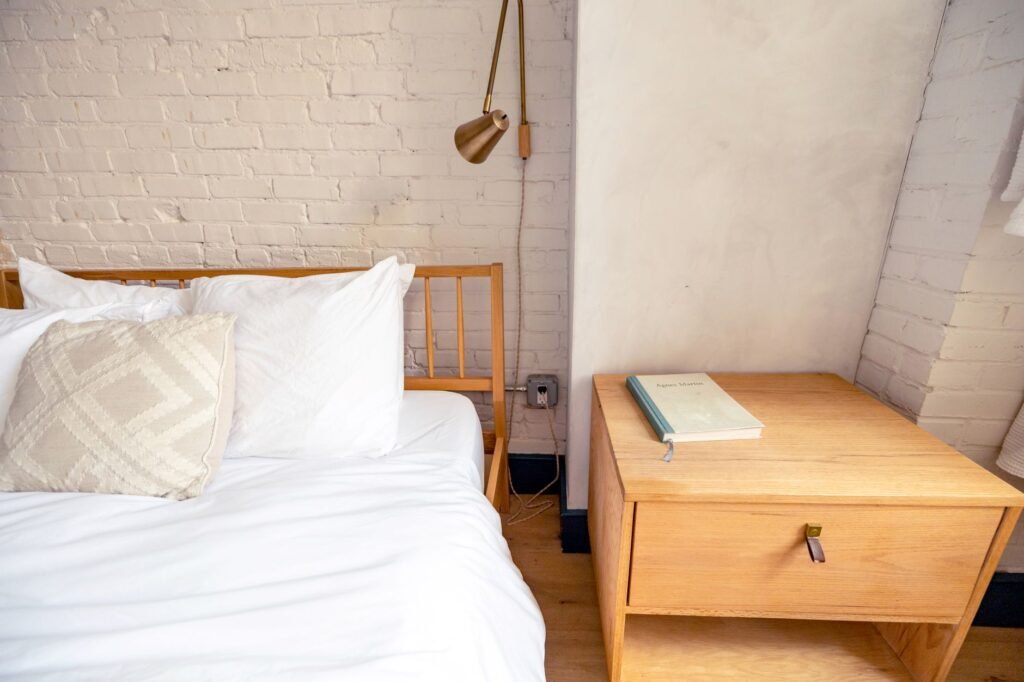
Why clutter can keep your brain on standby
Research on the home environment offers a useful clue. In one study, people who described their homes with more language tied to clutter and unfinished business showed patterns suggesting that home felt more stressful and less restorative. That does not prove a messy bedroom causes insomnia. It does suggest that your room can function as either a recovery space or a low-grade stress cue. (pubmed.ncbi.nlm.nih.gov)
Another body of sleep research helps explain the mechanism. Unfinished tasks are linked with rumination, and nighttime cognitive arousal is associated with worse sleep initiation and more wakefulness. The practical takeaway is that not all clutter carries the same weight. A lamp or framed photo is usually passive. A return box, paperwork stack, laptop sleeve, or clean-clothes chair is active clutter because it gives your brain something to work on when you are trying to settle down. (pmc.ncbi.nlm.nih.gov)
This is why some people can sleep in a room that looks slightly messy by design but struggle in a room that contains obvious open loops. The problem is usually not stuff in the abstract. The problem is visible stimulation, decision-making, and reminders close to bedtime. That lines up with sleep advice from the CDC and NIH, which emphasizes making the bedroom feel relaxing and reducing electronic stimulation before bed. (cdc.gov)
Use the BED Load Score before you buy another organizer
If you wish to create an item that helps alleviate your mental load you can do so by using your BED Load score. First stand at the door of your bedroom then sit on your bed and give a score of 0-3 to every visible item or pile in the room. Note that the score does not matter whether or not the object is attractive or costs a great deal of money, but rather if the object creates an amount of mental load on you at night.
- B – Belongs elsewhere: This item has a better permanent home outside the bedroom.
- E – Emits a task: Seeing it reminds you to fold, file, pay, return, charge, answer, clean, or decide something.
- D – Draws you into devices or spending: It can trigger scrolling, comparison shopping, late-night ordering, or one more email.
In order to keep items on your shelves long-term, they must have a fixed point in your home (score 0-1). If you have a score of 2, you should remove them from your home tonight. If you receive a score of 3 please remove them from your home before anything else. Items with the ability to trigger the bedroom as a to-do list or shopping list are highly likely to cause this kind of behavior.
What deserves bedroom real estate
| Visible item or pile | Typical BED score | Why it keeps your mind active | Lowest-cost move |
|---|---|---|---|
| Laundry chair | 2 | Signals unfinished work and usually creates a decision at bedtime or in the morning. | Use one hamper or one hook system. Dirty items go in the hamper. Clean items get hung or folded the same day. |
| Mail, receipts, unpaid bills, work papers | 3 | Administrative clutter is almost pure mental activation. | Move all paper to one household paper station outside the bedroom. |
| Open returns, shopping bags, shipping boxes | 3 | These trigger decisions, spending thoughts, and errands. | Move them to the car, entryway return shelf, or a single closet bin with a deadline. |
| Phone chargers, tablet stack, laptop bag | 2 to 3 | Screens invite late stimulation and make the room feel less restful. | Create one charging spot outside the bedroom or at least out of sight and out of arm’s reach. |
| Extra linens and overflow toiletries | 1 | Usually low task load, but they add visual noise if left open. | Store them under the bed or in one closed container. |
| Sentimental projects or hobby supplies | 2 | They can create guilt about what you have not started or finished. | Archive them elsewhere unless they are actively in use and contained. |
| Decor that does not demand anything from you | 0 to 1 | Passive items are less likely to trigger cognitive work. | Keep only what the room can hold without blocking surfaces or sightlines. |
This is not about a minimalist magazine. This is about getting your room to activate less at night. To achieve this, most bedrooms need items to be categorized into only three groups: supports for sleep when you are there, things you will need the next morning when you get out of bed, and a small number of comforting items. All other items should either be put away in another spot or be removed to another room.
A low-cost reset beats an expensive storage spree
Here is a composite example. Tasha and Eric share a 10-by-12 bedroom and were ready to spend $240 on a storage bench, drawer inserts, and decorative baskets. Before buying anything, they used the BED Load Score on 14 visible clusters. Ten scored 2 or 3, including a laundry chair, a laptop corner, two shopping bags with returns, a pile of unopened skin-care items, and a tangle of chargers. Their actual spend after subtracting first was $38: a lidded hamper and two under-bed zipper bags. They also returned $74 of unopened items and skipped the original $240 purchase. Relative to the first plan, that kept $276 in their budget and left them with a room that asked less of them at 11 p.m.
One important money lesson people don’t understand is when you have too much clutter, it makes you buy “organize around” those things. The general rule is to remove what you don’t use first, then purchase a new item later. If you have not taken out at least one-third of the things that scored a “2 or 3” (on a 0-3 scale) from your home, then you should not buy containers to store things until you have fewer items that were just removed. You need fewer reminders to organize things.
A useful spending rule: set your bedroom reset budget before you shop. For many households, the right number is not what you can afford. It is the smallest number that solves the last 10% of the problem after reduction is finished.
The 45-minute bedroom reset
- Start with the pillow view. Remove every visible item or pile that scores 2 or 3 from the place you can see when lying down.
- Take out task clutter before storage clutter. Mail, receipts, returns, work papers, beauty-product boxes, and anything that says deal with me tomorrow should leave the room first.
- Move chargers and screens. CDC guidance recommends turning off electronic devices at least 30 minutes before bedtime, so create a charging spot outside the bedroom if you can. (cdc.gov)
- Give laundry one container, not one chair. If clothes are dirty, they go in the hamper. If they are clean, they get folded, hung, or moved out of the room.
- Protect the three surfaces that matter most: the nightstand, the floor beside the bed, and the top third of your dresser. These surfaces set the tone when the lights go down.
- Set a hard cap on purchases. Buy only what the remaining items need, not what the original clutter made you think you needed.
- End with a five-minute nightly reset. Clear cups and wrappers, put tomorrow’s clothes where they belong, and restore the room before your wind-down starts.
If your bedroom also serves as an office, nursery, or dressing room, aim for concealment and zoning rather than perfection. A lidded tote for work gear, one closed paper box, and a firm screen cutoff can be enough to make the sleep zone feel separate. The standard to chase is relaxing and low-stimulation, not empty. (cdc.gov)
Common mistakes that turn clutter into a recurring expense
Most failed bedroom resets do one of two things: they attack low-impact clutter first, or they turn into a shopping list. Watch for these patterns.
- Buying bins before reducing the number of visible problem items.
- Treating a temporary pile as a system, especially for returns, clean clothes, or paperwork.
- Keeping bills, receipts, or work materials in the bedroom because it feels safer than losing them elsewhere.
- Leaving chargers on multiple surfaces so the room still reads like a command center.
- Using sentimental guilt to justify unfinished projects beside the bed.
- Trying to declutter the whole home instead of the five highest-load bedroom hotspots.
- Adding open shelving when the real problem is that the room already has too many visual cues.
When a cleaner room is not enough
Decluttering helps most when clutter is the cue that keeps your mind busy. But it is not the only bedroom variable that matters. Sleep research also points to temperature, noise, air quality, and in-bed device use as meaningful parts of the sleep environment. In one observational study, within-night sleep efficiency fell as bedroom PM2.5, temperature, carbon dioxide, and noise increased. CDC and NIH guidance likewise emphasizes a room that is quiet, cool, dark, and relaxing. (pubmed.ncbi.nlm.nih.gov)
If you still cannot fall asleep after a cleaner-room trial, look for larger drivers: chronic insomnia, pain, anxiety, shift work, loud snoring, or waking up gasping. MedlinePlus notes that good sleep habits often help short-term insomnia, while cognitive behavioral therapy can help chronic insomnia. In plain terms, decluttering is one lever. It is not a substitute for medical or mental health care when sleep problems continue. (medlineplus.gov)
This article is for informational purposes and is not medical advice. If sleep problems last more than a few weeks, or you have loud snoring, breathing pauses, major daytime sleepiness, or mood symptoms, talk with a licensed clinician or sleep specialist. (medlineplus.gov)
How to verify that the reset is actually helping
- On night 1, count how many clutter clusters you can see from bed.
- For 14 nights, record three things in a note or notebook: estimated time to fall asleep, number of awakenings you remember, and whether you picked up your phone after lights out.
- Repeat your visible-clutter count on night 7 and night 14.
- If clutter goes down but sleep does not improve, test the next variables in order: screens, light, noise, temperature, then schedule consistency. (cdc.gov)
- If sleep improves, keep purchases limited until the new room behavior has held for two weeks.
- If nothing changes and symptoms are persistent, move from self-experiment to professional help. (medlineplus.gov)
The standard to look for is boring consistency, not a perfect room. If your visible-clutter count drops, your late-night phone pickup drops, and you feel less tempted to handle admin tasks from bed, the reset is doing its job. If nothing changes after a short trial, the backup plan is not to buy more storage. It is to audit light, noise, temperature, schedule, and possible insomnia symptoms next. (cdc.gov)
Bottom line
The bedroom clutter problem is usually not about owning too little storage. It is about letting sleep space double as task space. When visible items behave like reminders, your brain stays on call. Remove the things that belong elsewhere, emit a task, or draw you into devices and spending first. Then, if you still need storage, buy the smallest fix that supports the room you already reduced. (pubmed.ncbi.nlm.nih.gov)
FAQ
Is a messy bedroom actually bad for sleep, or just annoying?
Not automatically. The better question is whether the mess creates visible unfinished tasks or screen temptation. Official sleep guidance says the bedroom should feel relaxing, and research on home stress, unfinished tasks, and cognitive arousal suggests that open loops can keep the mind more active at night. (cdc.gov)
What if my bedroom is also my office?
Then focus on boundaries, not perfection. Keep work items in one closed container, clear them out of sight before your wind-down starts, and move charging away from the bed if possible. That approach fits standard sleep guidance to keep the room relaxing and limit electronics before bedtime. (cdc.gov)
Should I buy organizers first?
Usually no. Reduce first, then buy only for the items that truly need a home. Otherwise, you risk paying to preserve a problem that subtraction would have solved more cheaply.
How long should I test a decluttered bedroom before deciding it helped?
A two-week-long experiment is applicable to most home settings. You have enough time at night to see if your sleep initiation, using your phone after you turn your lights out and clutter that can be seen with eye contact is improving; however, two weeks gives you enough data to continue this experiment; two weeks does not provide sufficient data to add to your experiment for several months.
Can I keep laundry in the bedroom if space is tight?
There is one rule that applies only to one type of container: dirty clothes go into a hamper; clean clothes get folded, hung, or otherwise placed out of your way. Therefore, the real challenge is not locating clothes in the room but determining whether the room presents itself as a decision-maker to you each night.
When should I talk with a doctor or sleep specialist?
If sleep problems keep going for more than a few weeks, or you have loud snoring, gasping, breathing pauses, major daytime sleepiness, or strong anxiety around sleep, it is time to get professional help. Good sleep habits can help, but chronic insomnia may need a more formal treatment plan such as CBT-I. (medlineplus.gov)
References
- CDC: About Sleep – https://www.cdc.gov/sleep/about/index.html
- CDC NCHS Data Brief No. 559: Short Sleep Duration and Sleep Difficulties Among Adults: United States, 2024 – https://www.cdc.gov/nchs/data/databriefs/db559.pdf
- NHLBI: Healthy Sleep Habits – https://www.nhlbi.nih.gov/health/sleep-deprivation/healthy-sleep-habits
- MedlinePlus: Insomnia – https://medlineplus.gov/insomnia.html
- PubMed: No Place Like Home: Home Tours Correlate With Daily Patterns of Mood and Cortisol – https://pubmed.ncbi.nlm.nih.gov/19934011/
- PMC: The Effects of Bedtime Writing on Difficulty Falling Asleep – https://pmc.ncbi.nlm.nih.gov/articles/PMC5758411/
- PubMed: Zeigarnik’s Sleepless Nights – https://pubmed.ncbi.nlm.nih.gov/27101340/
- PubMed: Nocturnal Cognitive Arousal Is Associated With Objective Sleep Disturbance – https://pubmed.ncbi.nlm.nih.gov/32247571/
- PubMed: Associations of Bedroom PM2.5, CO2, Temperature, Humidity, and Noise With Sleep – https://pubmed.ncbi.nlm.nih.gov/37076419/