
Discuss habitual loud snoring with a clinician, especially if you also have breathing pauses. Other signs include waking up with the sensation of choking, gasping for air, or having difficulty staying awake throughout the day. If you snore and are not showing other signs of sleep disordered breathing, your clinician may want to discuss this with you at a later, routine appointment. Other signs such as gasping, choking or the inability to stay awake during the day, should be discussed with your clinician as soon as possible, even if you have not had a routine appointment recently. Sleep disordered breathing, such as apnea, should not be ruled out due to lack of proof.
Listen for more than volume
Telling a clinician "You're incredibly loud" will not help them very much. In obstructive sleep apnea, the upper airway becomes obstructed and narrows, thereby interrupting normal respiration and normal sleep. A partner may notice events that you are not aware of, and should be viewed as helpful, but should not be relied on to validate a cause.
Imagine me, in a hypothetical scenario, searching through my phone for a snoring recording while trying to schedule an appointment. I’m frustrated I have to make a simple phone call at the end of the day. I give up with the search, and write down what was actually recorded: numerous pauses followed by deep gasping. A recording is not a key to a door.
When you say "I have no energy" and "I keep falling asleep without meaning to" during your description of your day, they mean different things to your clinician. Both require further evaluation. However, unintended dozing points to sleepiness more directly. Along with that, you may have headaches in the morning. You may also not feel refreshed after a night of sleep. These may help describe your symptoms, though they do not indicate sleep apnea.
Sleeping alone means no one may witness your symptoms of sleep apnea, and therefore it may go unreported. Normal body weight does not mean apnea is not present. Along with that, normal body weight does not mean it is not present. Along with that, feeling alert does not mean it is not present. I would not rule out a breathing concern because you may not appear like a "typical" sleep apnea patient.
Bring a short history, not a dossier
You can begin with primary care or a sleep clinician. The clinician may perform an office evaluation and may ask about your health conditions and symptoms; use medications; and sleep habits. A sleep study may assess if you have apnea, what type you have, and how severe it is. Too little sleep and other causes of sleepiness may be present, so the discussion should be more expansive than just snoring. I would take a short note like the one above and omit the things I do not know and mark it as “unknown.”
- Breathing: Reported pauses, gasping, or choking, or no observer.
- Pattern: Frequency and when did you first notice it.
- Daytime Function: Unintended dozing, difficulty concentrating.
- Sleep Opportunity: Sleep and wake times, how much sleep you got, and how many times you were awoken.
- Context: Medicine use, alcohol use, any health conditions, and sleep driving.
This is an appointment aid. Don't try any other sleep aids or remedies or use this as an excuse to put off contacting your provider.
A home test can help, but isn’t an automatic all-clear
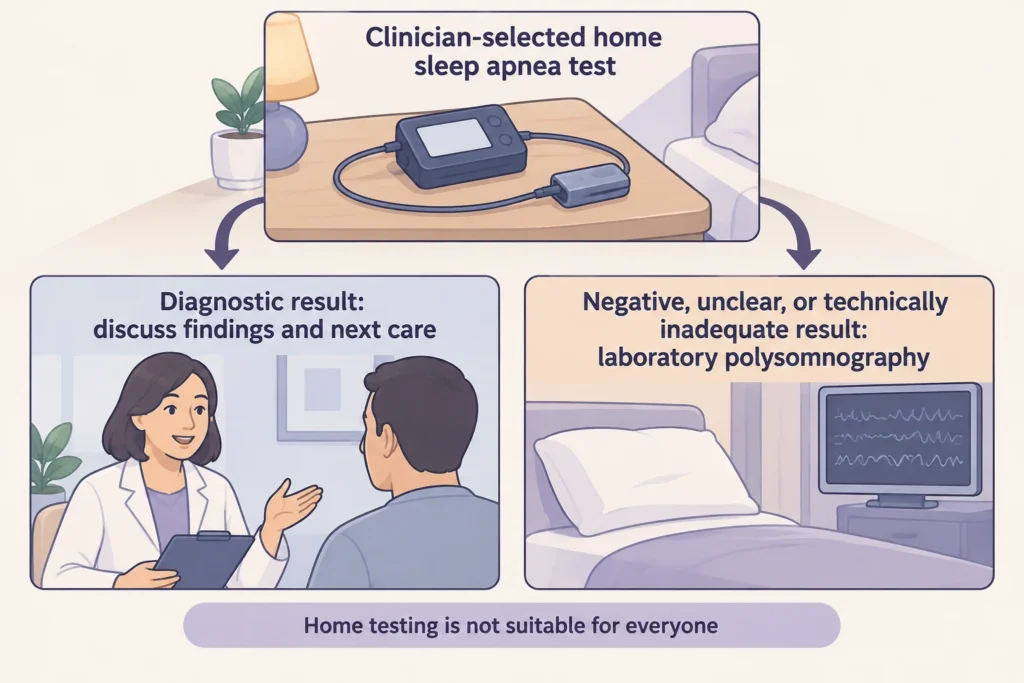
This questionnaire can help your clinician evaluate your risk, but can't confirm your diagnosis. A home sleep apnea test is a convenient option if you don't have any complicating conditions and an increased likelihood of moderate-to-severe obstructive apnea. I don't consider those conditions as hurdles that you have to clear to warrant seeking help. Those conditions are more about what type of evaluation the clinician should order, and if the data should be interpreted by a physician, instead of an automated score.
A laboratory study known as polysomnography, is the evaluation of your sleep and respiratory patterns over the course of a single night. This study is recommended by the American Academy of Sleep Medicine in lieu of home testing if you have significant heart or lung disease, neuromuscular diseases that affect your breathing, hypoventilation, chronic opioid use, a previous stroke, or severe insomnia.
Convenience is important, but these conditions can require measurements that a home test may not adequately provide, including assessment of breathing problems beyond a straightforward airway obstruction.
A negative home test requires little care. Many home tests do not measure sleep time directly, so events that occur during sleep may be undercounted if the individual is awake for part of the test. Devices vary, but the AASM pathway recommends further testing after a negative, inconclusive, or technically inadequate home study. If you are given a “negative” report, ask what the follow-up testing plans are, not what you need to do to prove your symptoms all over again.
Sources and references
- National Heart, Lung, and Blood Institute: Sleep Apnea, Symptoms (2025-01-09)
- National Heart, Lung, and Blood Institute: Sleep Apnea, Diagnosis (2025-01-09)
- American Thoracic Society: What Is Obstructive Sleep Apnea in Adults?
- American Academy of Sleep Medicine; Journal of Clinical Sleep Medicine: Clinical Practice Guideline for Diagnostic Testing for Adult Obstructive Sleep Apnea (2017-03-15)
- American Thoracic Society; American Journal of Respiratory and Critical Care Medicine: Sleep Apnea, Sleepiness, and Driving Risk in Noncommercial Drivers (2013-06-01)
- American Thoracic Society: Sleepiness and Driving
- American Academy of Sleep Medicine: Clinical Use of a Home Sleep Apnea Test: An Updated AASM Position Statement
- American Academy of Sleep Medicine: A Patient’s Guide to Understanding Diagnostic Testing for Obstructive Sleep Apnea in Adults