
Reasonable adjustments to sleep habits that still leave you awake for hours warrant an insomnia assessment and specifically a CBT-I assessment. I wouldn’t suggest adding to your existing bedtime checklist. The American Academy of Sleep Medicine supports the use of multicomponent cognitive behavioral therapy for insomnia (CBT-I) for chronic insomnia and suggests against the use of sleep hygiene education alone for the treatment of chronic insomnia.[1]
Keep positive bedtime habits. Just because positive habits don’t fix the entire problem doesn’t mean you’re not disciplined and need to add more negative habits to your bedtime checklist in order to ‘earn’ sleep.
Picture me in an imagined evening: the phone is parked outside the bedroom, the lights are dim, and I’m hunting for the notebook where I’m supposed to record one more calming exercise. I’m tired and annoyed that preparing for sleep has acquired paperwork. Instead of adding the exercise, I write down a different task: ask about insomnia treatment. That’s the change in effort I mean.
Is the problem too little opportunity, or difficulty sleeping?
If your schedule leaves you with only 5 hours of opportunity for sleep, limited opportunity is part of the problem and insomnia treatment cannot create more opportunity. Insomnia is defined as a difficulty in sleeping despite adequate opportunity and circumstances for sleep. Sometimes, people can experience both insufficient opportunity and insomnia. That is why, for an assessment, your actual schedule, not your intended bedtime, is important.[3]
Not every period of poor or inconsistent sleep means that you have chronic insomnia. When evaluating possible insomnia, clinicians are looking for the presence of concerns related to your ability to fall asleep or to stay asleep at least three times a week, for a duration of at least three months, together with daytime fatigue or impairment and the opportunity to obtain adequate sleep. The presence of these concerns is the threshold for initiating an assessment and does not confirm or deny a diagnosis of insomnia. You do not need to wait three months to seek help if your insomnia is making it difficult for you to function at home, work or school.[3][4]
Mention loud snoring or gasping, an uncomfortable urge to move your legs at night, and whether you sleep much more easily on a later schedule. Those clues can change what needs assessment. Persistent wakefulness alone doesn’t tell us whether insomnia, a timing problem, another sleep disorder, medication effects, or several factors are involved.[3][4]
CBT-I does more than help you relax
CBT-I works to change specific thoughts and behaviors related to sleep. It's not just general CBT with a bedtime handout. It doesn't mean your issues are “all in your head.” The AASM states that the average length of a course is between four to eight sessions, though this can obviously vary case-to-case and based on the format of treatment.[2][3]
Two components change your relationship with your bed. Stimulus control attempts to make the bed a conditioned response for sleep as opposed to prolonged wakefulness. Time-in-bed components attempt to make total sleep time (TST) the goal opposed to condensing total time in bed (TIB). The sleep diary aids in assessing if time-in-bed adjustments are working. It’s more specific than just telling a patient to wind down.[3]
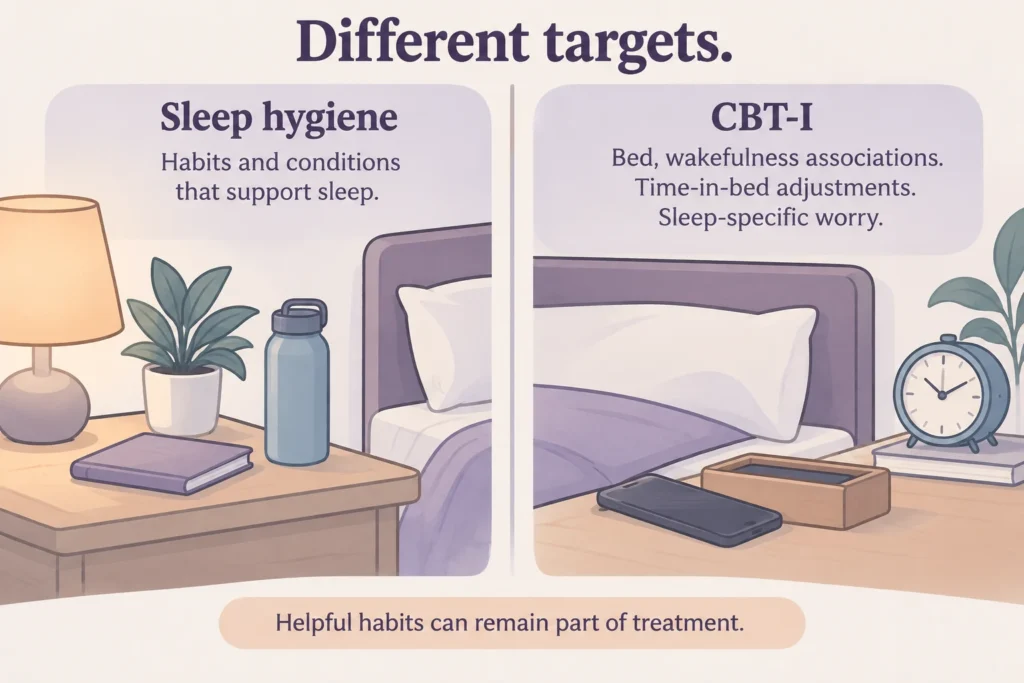
Cognitive work focuses on changing expectations, rules, and predictions related to sleep. These can include, “One bad night means tomorrow will be unmanageable.” It’s not about forcing positive expectations. The objective is to relieve the burden and rule related to sleep. Other aspects of the program can help as well, and these should be incorporated, but the focus should be on the other aspects as well. The distinction I find helpful is that your effort is focused beyond developing an additional relaxation or soothing ritual.[1][3]
The sleep-restriction part needs care
Therapy will include techniques to limit your time in bed. This may sound like it’s telling you to make yourself sleep deprived, however, it’s important to remember that it isn’t. This component may actually help with daytime sleepiness. Because of this, I wouldn’t recommend using a sleep window formula that you might find on the internet.[3]
There are some things you should tell your clinician before starting this component including, excessive daytime sleepiness, bipolar disorder/manic episodes, seizures, risks of falling, work that involves driving or operating hazardous machinery, changes in your work schedule, caregiving that involves over-night shifts, etc. There are situations where your clinician may recommend making adjustments to your CBT-I rather than not using CBT-I at all.[3]
Monitoring isn’t just checking whether you slept longer. It includes reviewing your diary alongside how you function during the day, then adjusting treatment if the burden or risk is too high.[3]
Make the first appointment useful
Beginning with your primary care physician is also an option. Explain that you have implemented lasting changes to your sleep habits, but still have long periods of wakefulness that adversely impact your day. Request an assessment and possible intervention for insomnia, as well as an assessment and possible intervention for other sleep related problems, including access to CBT-I.
If practical, bring one to two weeks of a simple sleep diary: approximate bedtime, time to fall asleep, nighttime waking, final waking, getting-up time, and naps. Also include how long you’ve had the symptoms, what you’ve done to try to alleviate the symptoms, what medications and supplements you take, if you drink caffeine or alcohol, what constraints your schedule has, and if you have any daytime effects. Estimates are fine. You don't need to wait for an appointment to collect the information. If you wish, you can bring the information to your next appointment. Don't let the worry of not being able to collect the perfect information keep you from seeking help.[4]
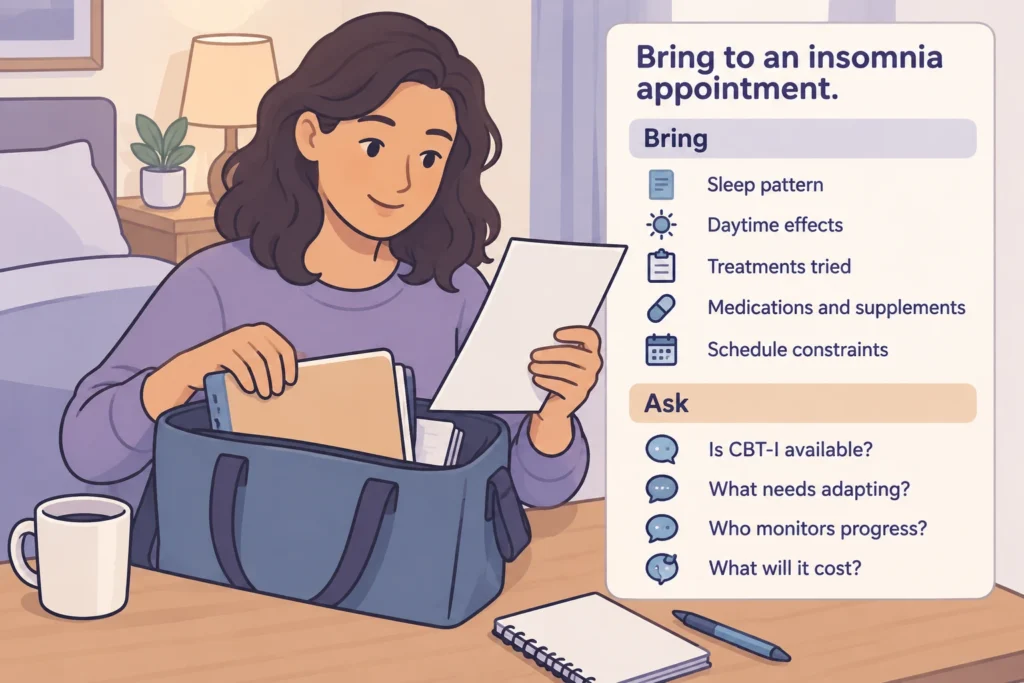
Two questions I have are: “Is there anything in CBT-I that needs to be modified due to my health or schedule?” and “Who will oversee my care, and is it possible to contact them in the case that my daytime sleepiness gets worse?”
Find treatment without buying blindly
It’s important to confirm that your provider will indeed offer CBT-I, as opposed to only general counseling or sleep recommendations. The Society of Behavioral Sleep Medicine has a state-based telemedicine directory and links to an international CBT-I provider directory. A listing won’t help you learn whether someone has openings, takes your insurance, or provides treatment where you are. Contact them to learn those things before you make an appointment.[7]
| Option | What to ask |
|---|---|
| Clinician-delivered CBT-I, in person or by telehealth | Likely total cost? Insurance accepted? Who tailors treatment and reviews sleepiness? |
| Brief behavioral treatment | Is a shorter insomnia-focused course available? AASM describes brief treatment as often one to four sessions. |
| Structured digital CBT-I | Evidence for this program? Diary-based feedback? Risk screening? A route to human help? |
I don’t think I’d completely discount digital CBT-I based on it being asynchronous. In a 2025 systematic review, completely automated programs were shown to improve Insomnia Severity compared to a few control conditions, and programs and study populations were varied. In three direct comparisons, therapist-supported treatment was shown to be better. This is a small body of evidence, and it doesn’t mean that digitally delivered CBT-I isn’t appropriate for everyone. Likewise, just because an app is labeled “sleep” or “CBT” does not mean the evidence is good.[5]
If your budget is an issue, check out VA’s free, publicly available Insomnia Coach. CBT-i Coach, on the other hand, is to be used in conjunction with treatment. VA’s Path to Better Sleep hub also includes SleepEZ, described as digital CBT-I. These resources don’t replace needed assessment, and their availability doesn’t establish that unsupervised use is appropriate or equivalent to clinician care.[6][9]
If access is slow, or treatment isn’t helping
While waiting, keep the steady parts of your routine, and don’t completely restart the experiment. Contact your provider to ask about treatment cancellation, group treatment, brief treatment, telehealth or other digital, structured activities that fit your health situation. Persistent daytime impairment still warrants assessment, especially if you’re on a long CBT-I wait list.[2][3][4][7]
If you feel treatment isn’t helping, come back to the clinician with your diary and the actual barriers to your plan. You can adjust or stop treatment if you feel that isn’t the best use of your time. Ask if there’s other support available. I’d rather see the plan questioned than see you feel like you’ve failed at sleeping.[3]
Sources and references
- American Academy of Sleep Medicine: AASM behavioral and psychological treatment guideline (2021-02-01)
- American Academy of Sleep Medicine: AASM patient guide to behavioral insomnia treatments
- Department of Veterans Affairs and Department of Defense: 2025 VA/DoD chronic insomnia and obstructive sleep apnea guideline (2025-01)
- National Heart, Lung, and Blood Institute: Insomnia diagnosis
- npj Digital Medicine: Systematic review and meta-analysis on fully automated digital cognitive behavioral therapy for insomnia (2025-03-12)
- VA National Center for PTSD: Insomnia Coach
- Society of Behavioral Sleep Medicine: Society of Behavioral Sleep Medicine telemedicine providers
- American College of Physicians: ACP 2016 chronic insomnia guideline status notice
- Department of Veterans Affairs: Path to Better Sleep current course hub