Your tracker only estimates deep sleep. It can’t measure brain activity to define it. Don’t let an estimate change your routine, or make you buy a supplement or seek medical treatment. Broader sleep patterns can be helpful, but an estimate of a total of a stage cannot explain symptoms.[1][3]
What the device records, and what it guesses
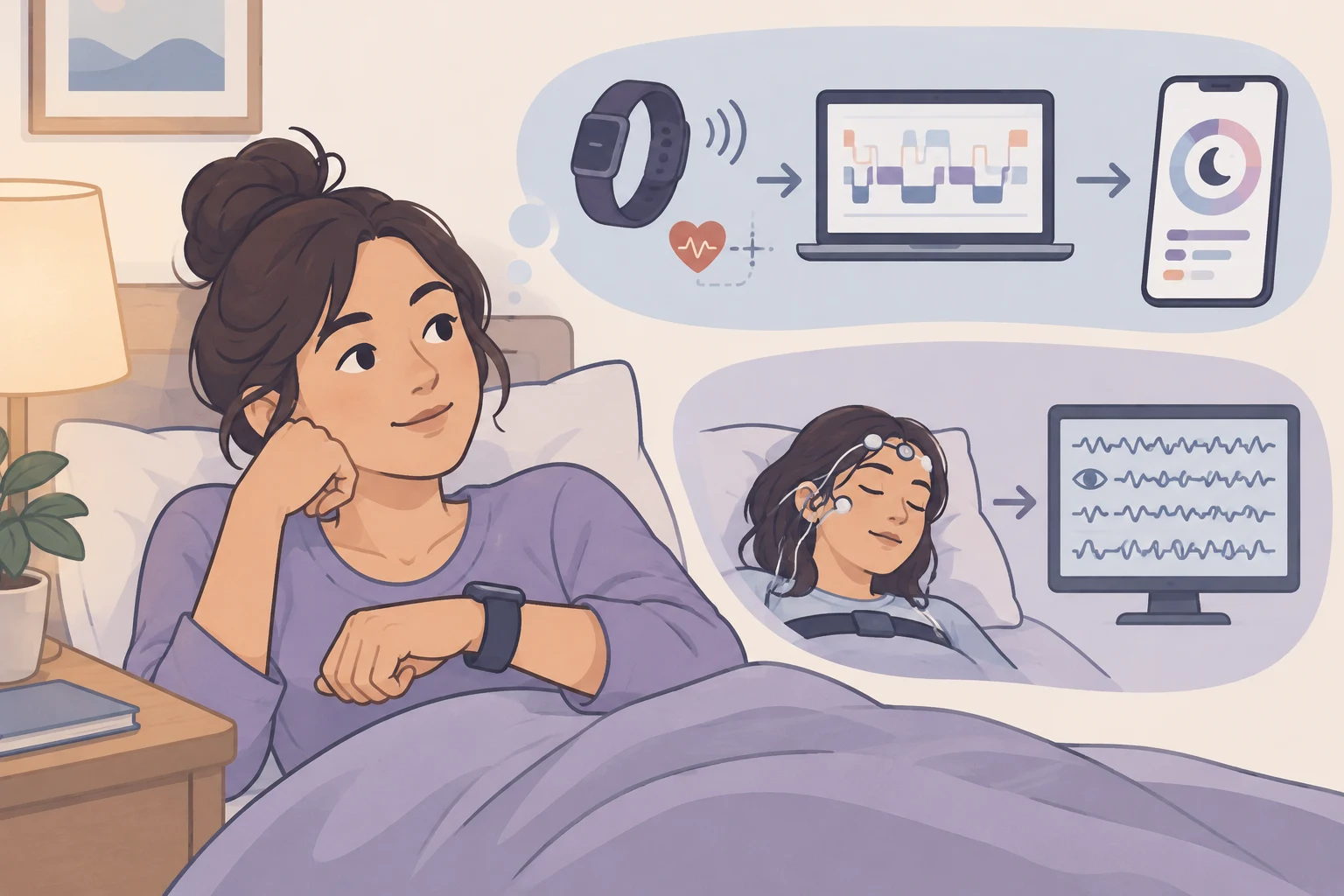
Clinical sleep staging uses polysomnography, or PSG, including brain-wave, eye-movement, and muscle recordings. Deep sleep, called N3, is identified from characteristic brain activity. Mainstream wrist and ring trackers instead infer stages from indirect signals such as movement and optical pulse measurements. Inputs differ: Apple’s October 2025 technical paper describes accelerometer-based staging. Heart-rate patterns can provide clues, but they aren’t brain waves.[3][5]
The app adds another layer by combining selected measurements and estimates into a proprietary score. Recording a signal, inferring a stage, and assigning a nightly grade are different operations, even when the dashboard presents them with the same neat precision.[3]
Picture me in an imagined morning: I feel reasonably rested, but the app reports very little deep sleep. You’re already running behind to get the kids to bed for the school day, and you’re wondering if you should set your bedtime even earlier. You’re considering all of this while standing next to your boiling kettle. You don’t appreciate the extra homework. You know you need to set bedtime earlier, but before you do, you should set down your phone and consider if the number justifies making that change.
“Accurate” needs a follow-up question
I would ask, “Accurate at what?” A tracker might be good at distinguishing wake from sleep, but not good at estimating total sleep time. Sleep stages are complex and, again, dependent on the individual. A 2026 systematic review of trackers in the healthy adult population found that the performance of various trackers in distinguishing each stage of sleep was variable and limits detailed interpretation. An independent polysomnography (PSG) comparison study, involving 34 healthy young adults, noted inconsistent staging, and general worsening of performance of the device in question, particularly during disrupted sleep, which are the nights when explanation is mostly needed. Although the devices used in the study are older, performance of newer devices in the market today remains limited by the same principles.[2][4]
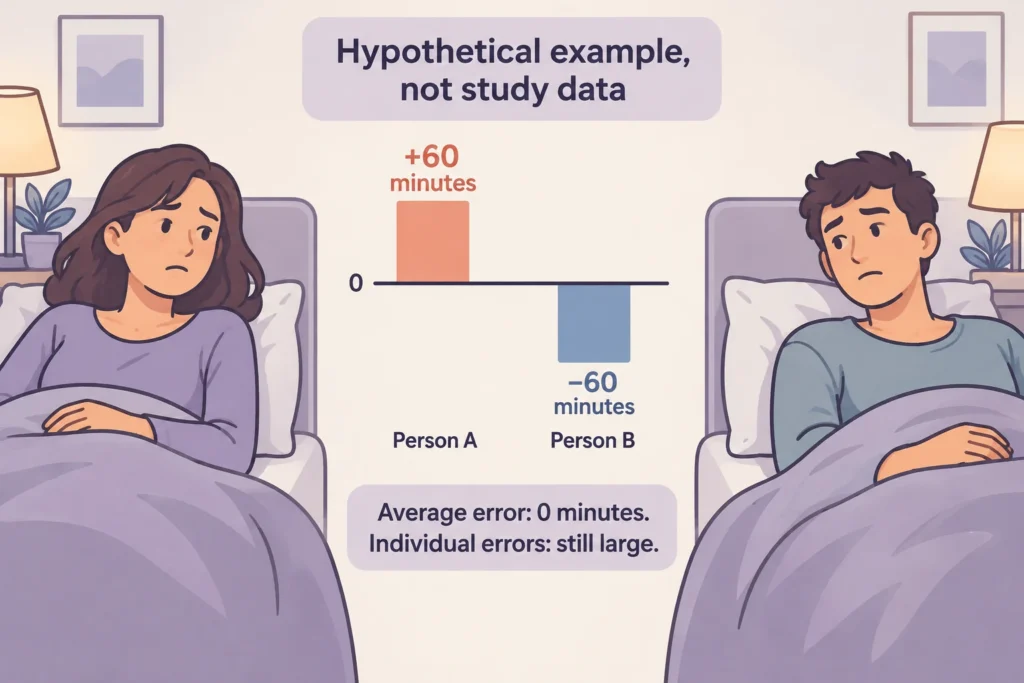
A small average error isn’t necessarily much comfort for you, either. In a hypothetical calculation, overestimating one person’s deep sleep by 60 minutes and underestimating another’s by 60 gives an average error of zero, although both estimates are an hour off. Looking across more nights can reveal patterns, but it won’t necessarily correct a device that consistently misclassifies your sleep.[2][4]
Findings for validation are only applicable for a specific population, study design and set of assumptions, and not for the wearable in general. Findings from studies on a healthy younger population do not necessarily apply to someone with fragmented sleep. Even if you are using the same wearable device, things can change. Apple's documentation states they made revisions to their staging algorithm in 2024 and 2025.[3][4][5]
What would actually change your evening?
I’d be more interested in the patterns and trends related to when you go to sleep, how much time you have to sleep, what you remember about wakefulness, how you function during the day. The World Sleep Society recommendations prefer looking at larger patterns, and larger trends, as opposed to clinical interventions, and answering based on proprietary scoring. Even larger patterns deserve a second look. If you’ve “slept” but your reported hour of being awake is part of that “sleep,” then I wouldn’t take the total time of that reported “sleep” as accurate.[3][4]
Midnight to 6 a.m. leaves six hours of sleep opportunity; 10 p.m. to 6 a.m. leaves eight. Neither guarantees that much actual sleep, but if evening tasks repeatedly squeeze your window to six hours, protecting more time addresses something concrete. You don’t need an accurate stage chart to notice those missing hours. If you have ample opportunity, feel well, and only the deep-sleep estimate looks poor, I’d leave the routine alone rather than give you another nightly job chasing an unsupported target.[3]
The important mismatch is with persistently poor sleep and daytime sleepiness. If the application gives good scores, but you still have frequent loud snoring and are sleepy during the day, you should have an assessment. Gasping and breathing pauses (and daytime sleepiness) can be symptoms of sleep apnea. However, even with the best deep-sleep scores, this can not be completely excluded. Do not drive if you are sleepy. You can bring a brief sleep history and explain what is going on during the day. As the AASM’s 2018 position statement describes, the sleep tracker may provide additional information, but it should not replace a clinical evaluation.[1][7]
You can stop checking
If tracking your sleep gives you anxiety and makes you feel like you need to spend more time in bed in order to earn a good score, try covering your sleep results or turning off sleep tracking for a week or two. You can also compare how anxious you feel and how functional you are during the day, without having to grade your sleep. This preoccupation with sleep tracking and anxiety is described in several case studies, but it doesn't prove that tracking your sleep causes insomnia. The pause is a personal experiment, not treatment. You do not owe the dashboard any more of your time.[6]
Sources and references
- American Academy of Sleep Medicine: Consumer Sleep Technology: An American Academy of Sleep Medicine Position Statement (2018-05-15)
- Behavioral Sleep Medicine; Agostinho and colleagues: Are Wearable Sleep-Tracking Devices Reliable Alternatives to Polysomnography? A Systematic Review and Meta-Analysis (2026-05-22)
- World Sleep Society Sleep Tracker Task Force: World Sleep Society Recommendations for the Use of Wearable Consumer Health Trackers That Monitor Sleep (2025-04-05)
- Sleep; Chinoy and colleagues, Naval Health Research Center: Performance of seven consumer sleep-tracking devices compared with polysomnography (2020-12-30)
- Apple: Estimating Sleep Stages from Apple Watch (2025-10)
- Journal of Clinical Sleep Medicine; Baron and colleagues: Orthosomnia: Are Some Patients Taking the Quantified Self Too Far? (2017-02-15)
- National Heart, Lung, and Blood Institute: Sleep Apnea Symptoms