
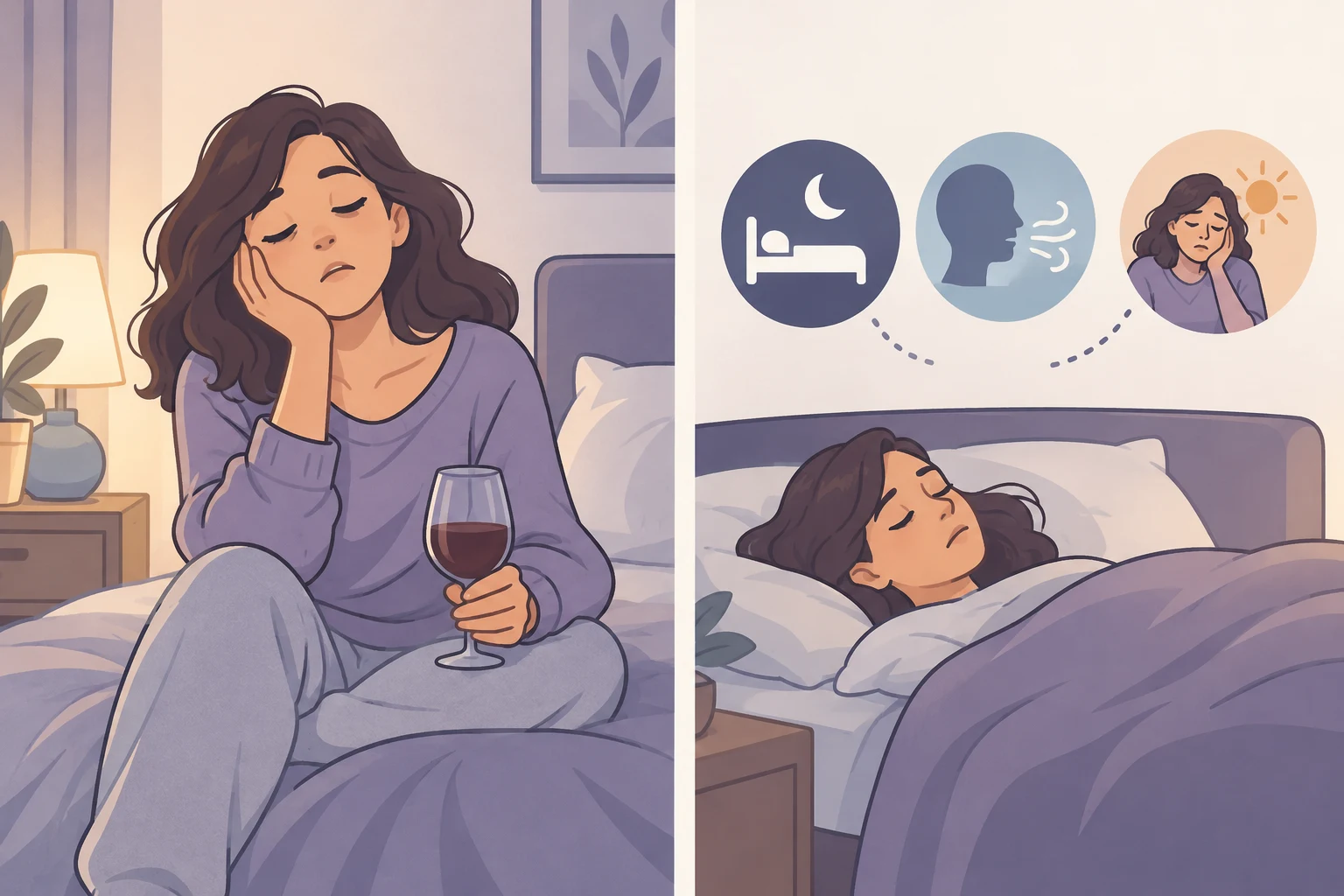
Yes. Alcohol can make you feel sleepy and at higher doses can reduce the time to fall asleep. Alcohol does change your sleep in several other ways that are not helpful. Treatment for alcohol-induced sleep should not be viewed as a positive. Getting to sleep faster doesn’t mean you’ll sleep well and function well the next day.[1][2]
An exception to altering a treatment method is if you’re physically dependent on alcohol and you abruptly stop or drastically reduce your alcohol consumption. Withdrawal from alcohol can be life threatening, and it is advisable to get medical help in withdrawal.[7][8]
The bedtime benefit is only one part of the night
Alcohol has a sedating effect which can help with falling asleep. This sedating effect can wear off and make sleep lighter and increase the likelihood of waking. Both effects are true. Not everyone has the same overnight schedule; not everyone wakes up at the same time.[1][2]
Imagine I’m facing a sink full of dinner dishes with bedtime already slipping away. I’m irritated, and a glass of wine looks like a shortcut to switching off. Before pouring it, I change the question from “Will this make me sleepy?” to “What am I hoping it will fix?” That’s the distinction I’d want you to keep: relief at bedtime matters, but it isn’t the whole result.
The claim that alcohol helps you fall asleep needs qualifying. A 2025 systematic review and meta-analysis of 27 studies on healthy adults showed a dose-dependent effect on sleep onset. Faster sleep onset was only noted at high doses. This is a good reason to question the nightcap recommendation, let alone increase the dose. Delay and reduction of REM sleep, one of the cycles your brain goes through during sleep, were noted at low doses.[1]
The review’s pooled findings were less clear about total sleep time, time awake after falling asleep, and sleep efficiency, the proportion of time in bed spent asleep. I wouldn’t use a REM change to explain your particular 3 a.m. waking or morning fog. Research can show that alcohol changes sleep without establishing why you feel tired.[1]
Amount matters more than the name of the drink
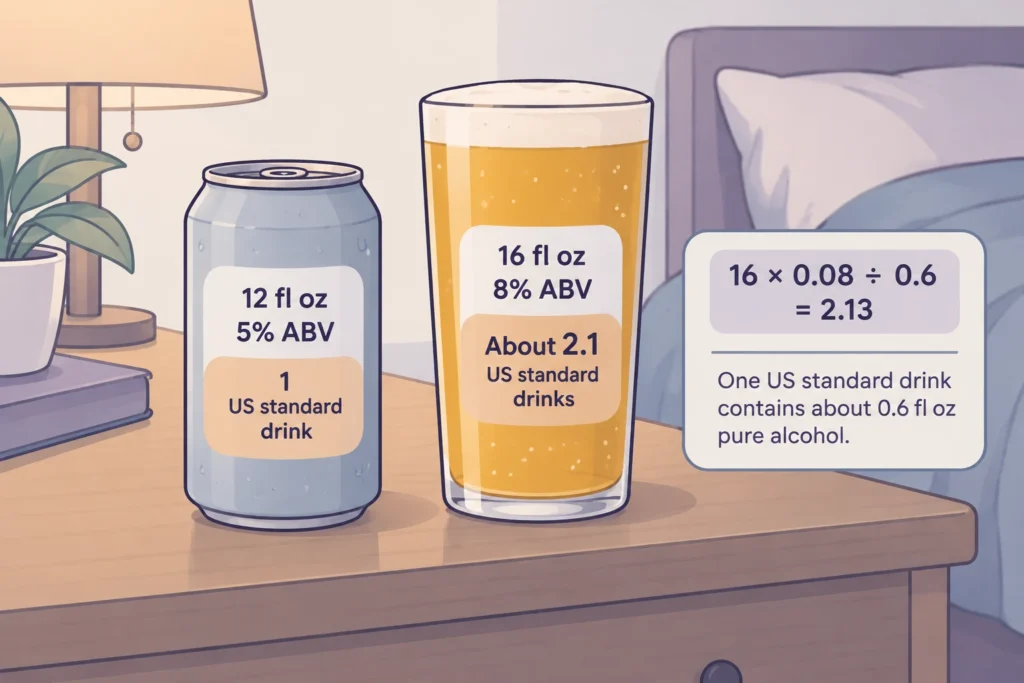
“One beer” can hide quite different amounts of alcohol. In the US, a standard drink contains 14 grams, or about 0.6 fluid ounces, of pure alcohol. A 12-ounce beer at 5% alcohol by volume contains one standard drink. A 16-ounce beer at 8% contains about 2.1: 16 × 0.08 ÷ 0.6 = 2.13. That calculation describes the alcohol amount; it doesn’t predict when you’ll clear it or identify a sleep-friendly dose.[3]
The research also doesn’t give me a reliable last-drink time. The majority of alcohol administrations in the 2025 review occurred within 3 hours of bedtime, so there wasn’t a lot of evidence regarding administrations further out. Moving your drink back further may change your experience. It doesn’t come with a proven three- or four-hour cutoff that protects sleep.[1]
Frequently, beverages that caused sedation in the past no longer do, and more drinks are required to obtain the sedating effect. Needing more alcohol over time to obtain sedation does not mean a person has alcohol use disorder, but it is something that warrants attention. Alcohol use disorder and other mental disorders often occur together, and sleep problems persist during the recovery from alcohol use disorder, so not drinking alcohol doesn’t mean a person will immediately have normal sleep.[4]
Breathing problems and medicines change the stakes
Use of alcohol may worsen breathing conditions during sleep. In a review of 14 studies, apnea and hypopnea events and respiratory pauses were higher after alcohol consumption. Average oxygen saturation levels were also lower post alcohol. Changes in breathing events after alcohol consumption were greater among snorers and those with obstructive sleep apnea. Studies had varying participants and methods, so they do not necessarily reflect your situation.[5]
Loud snoring with breathing pauses and/or gasping is indicative of sleep apnea and requires more than adjusting your nightcap. Tell your healthcare provider about your alcohol consumption. It may not always be the cause, and could be exacerbating a pre-existing condition.[5]
Other combinations of alcohol with opioids, benzos and/or zolpidem or other sleeping aids increase risk of breathing depressions and death. Never try to outsmart these risks. Alert your pharmacist or prescribing healthcare provider about your concerns and help adjust your medicines without independently modifying your treatment. If you think someone is at risk of stopping breathing, call 911.[6]
Reconsider the habit without turning it into a test of willpower
Alcohol withdrawal can cause shakes, sweating, nausea, rapid heart rate, and insomnia. If you experience any of these, seek medical help before slowly lowering or stopping your alcohol consumption if you’ve experienced alcohol withdrawal symptoms in the past. Long-term heavy drinking can put you at risk for withdrawal even if you’re not experiencing symptoms. You should see a doctor to assess if you need medically supervised withdrawal. I wouldn’t consider it safely manageable at home.[7][8]
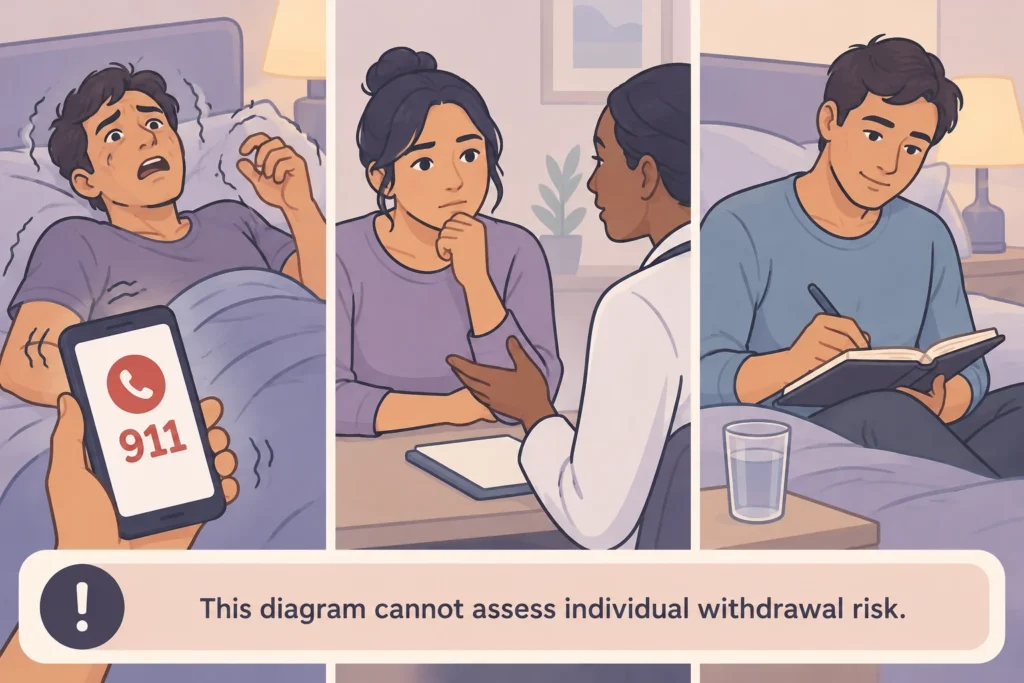
If you’re not experiencing symptoms of alcohol withdrawal, you could try to see if your alcohol use is negatively affecting your sleep. You could keep a small journal for a few days and note about how long it takes you to fall asleep, how many times you wake up, how rested you feel when you wake up, and how sleepy you feel during the day. You should try to keep the number of variables in your routine that change like your sleep opportunity and caffeine intake to a minimum. This can help you notice a pattern and see if you feel more sleep deprived. This isn’t a formal way to diagnosis sleep deprivation.
An improvement suggests alcohol may be part of the problem. No improvement wouldn't prove it was having no effect, and it wouldn't be a reason to restart drinking. A first difficult night wouldn't be a verdict, either. New-onset insomnia following the reduction of alcohol consumption, and especially if it is accompanied by physical symptoms, should be medically reviewed. It is irresponsible to write it off as a “rebound” effect.[4][7][8]
If your bedtime struggles continue or daytime symptoms persist, then you should be referred for an evaluation of insomnia, as opposed to further education on bedtime rules. Ask about cognitive behavioral therapy for insomnia, or CBT-I, the first-line treatment for chronic insomnia. Tell your practitioner what role alcohol serves for you. I'd want treatment for the insomnia to address the role alcohol helps you serve in the transition to sleep. I wouldn't simply want the alcohol removed and the challenge to sleep remain.[2]
Sources and references
- Sleep Medicine Reviews; Gardiner and colleagues: The effect of alcohol on subsequent sleep in healthy adults: A systematic review and meta-analysis (2025-04)
- National Heart, Lung, and Blood Institute: Insomnia, Treatment
- National Institute on Alcohol Abuse and Alcoholism: The Basics: Defining How Much Alcohol is Too Much
- National Institute on Alcohol Abuse and Alcoholism: Mental Health Issues: Alcohol Use Disorder and Common Co-occurring Conditions
- Sleep Medicine Reviews; Kolla and colleagues: The impact of alcohol on breathing parameters during sleep: A systematic review and meta-analysis (2018-12)
- National Institute on Alcohol Abuse and Alcoholism: Alcohol-Medication Interactions: Potentially Dangerous Mixes
- National Institute on Alcohol Abuse and Alcoholism: Understanding Alcohol Use Disorder
- MedlinePlus, National Library of Medicine: Alcohol withdrawal