

Yes, a medication could absolutely be part of the cause. If your sleep changed when you started a medication, changed the dose, or added a new medication, a comparison of those dates to your actual dosing schedule to your sleep symptoms may be useful. Bring that record to a pharmacist or prescriber. I wouldn’t suggest using skipping doses, stopping a medication, or spacing the medication around the clock as a home experiment. You don’t want to lose your treatment that may be helping and making your sleep worse in the process.[1][2]
There is an exception to that suggestion: if a product has its own “stop-use” warning, that warning trumps general suggestions not to change your treatment. Contact a pharmacist or your prescriber and give them your sleep log.[2][4][5]
Start with what changed, not a list of suspect drugs
Timing matters because a suspected cause needs a plausible relationship to the symptom. But “after” doesn’t automatically mean “because of.” Adverse-reaction assessment also considers the illness being treated, other medicines, and other explanations. Even a well-documented timeline can leave more than one possibility.[1]
Consider if the sleeping problem is truly new or has it been going on and just gotten worse? Was your work schedule changed? Did you begin using more caffeine? Was there an increase in anxiety, congestion, pain, etc. around the same time your treatment began? If so, your sleeping problem may not just be caused by your newest prescription.[1][6]
In an imagined example, I am awake beside a crumpled tissue box and practically blaming my regular prescription. I’m thinking of skipping it. However, I remember that I took the 12-hour congestion medicine on Tuesday. So, my prescription hasn’t changed in a couple of months. I move both packages to the other side of my phone. This doesn’t really answer the mystery, but this changes my presentation to the pharmacist.
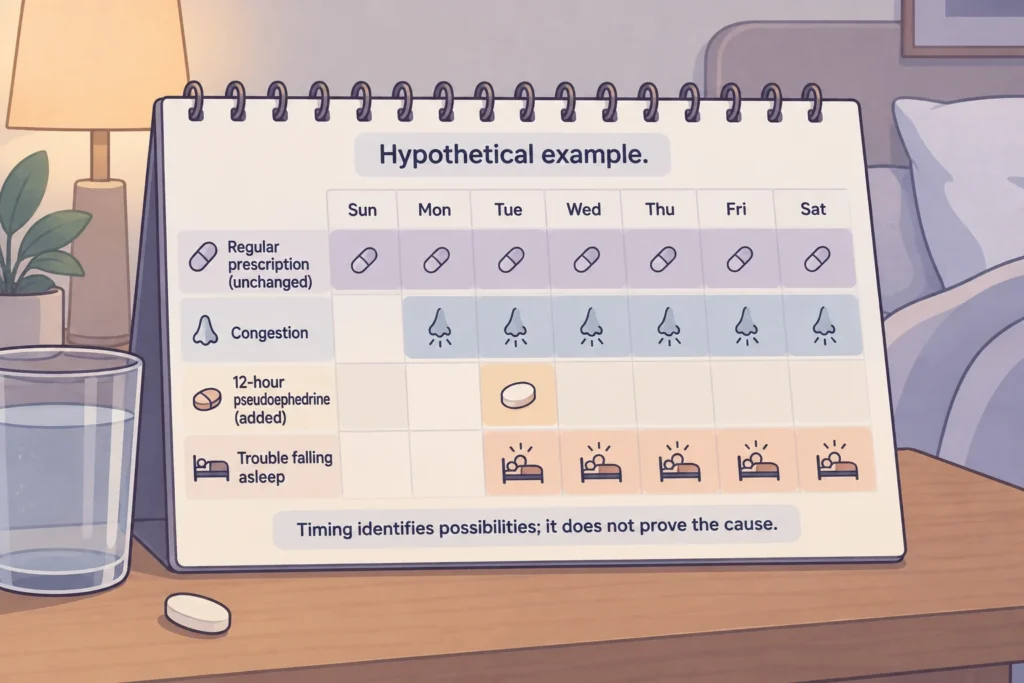
It is important to note the SUDAFED SINUS CONGESTION 12 HOUR label, which has extended-release pseudoephedrine, says to stop use and consult a doctor if sleeplessness, nervousness, or dizziness occur. This warning implies that the medicine might be the cause of sleeplessness, but in this case, the person might just be experiencing a normal case of sleeplessness. Congestion is still the main issue being reviewed.[1][5]
One phone note is enough to start
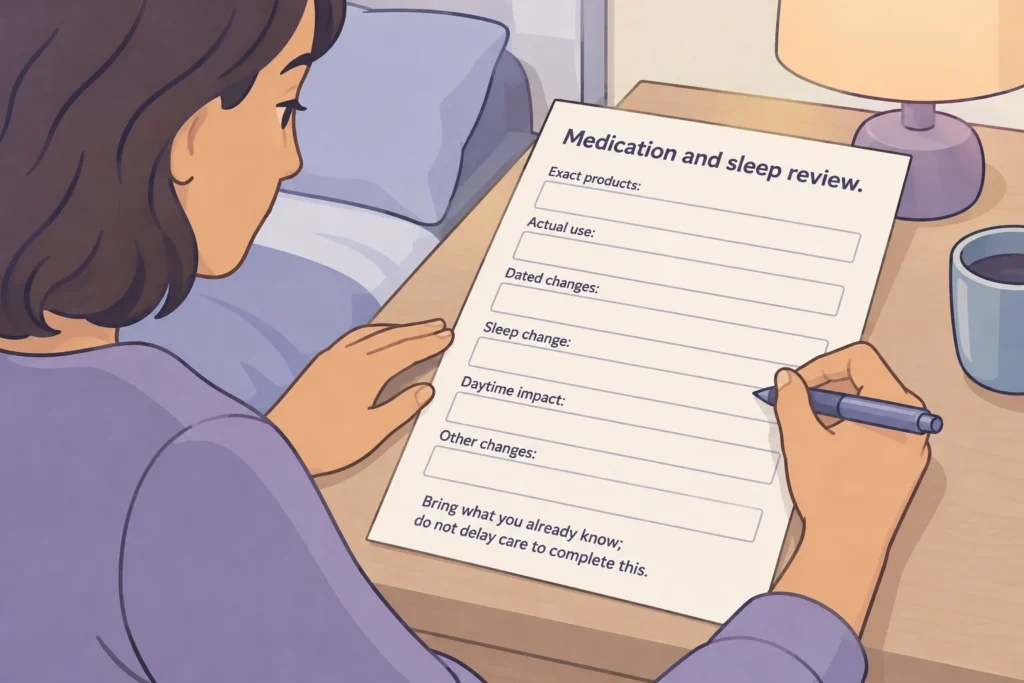
I’d rather have a few relevant details than to have to spend another evening building a spreadsheet. In the meantime, please fill in what you are able in these fields. Photos of packaged products are very helpful, particularly for combination products. This worksheet is designed to help you gather the information and is not intended to be used to diagnose an adverse reaction.
- Exact Products used: name, active ingredients, strength, and formulation (i.e. immediate release, extended release). Include prescription and OTC medicines, vitamins, herbal products, and supplements. Include sleep aids.
- Exact Use: amount and time taken. Include reasons for use and food instructions. Include as needed use, missed doses, and use in a different manner from label or prescription.
- Changes: when product was started, when dose or dosing time was changed, and when there was a change in product formulation or pharmacy refill. Approximate dates are okay if exact is not remembered.
- Sleep change: falling asleep, staying asleep and waking up too early. Include unusual dreams and daytime sleepiness. Compare to how you used to sleep.
- Daytime change: mood, being alert and staying alert, ordinary tasks, and responsibilities. Include mistakes and concerns about driving.
- Other changes may include symptoms of the treated condition, other illnesses, caffeine, nicotine, alcohol, cannabis, work hours, naps, and time available for sleep.
For OTC products, it’s important to identify the ingredients, rather than “cold medicine” or “nighttime pain reliever.” The boxes of these products often overlap, and individual components of combination products are easy to miss when making a medication list. A pharmacist needs to see the entire list to evaluate. Don’t take a sleep aid or other supplement to offset the problem before the pharmacist has a chance to evaluate the combination.[2][3]
A timing change is still a medication change
It’s reasonable to hope the answer might be a different dosing time rather than losing an effective treatment. Sometimes a professionally advised timing adjustment is an option. But “take it earlier” leaves out dose spacing, food requirements, release formulation, interactions, and when the medicine needs to control your symptoms. Those details have to be resolved for your exact product.[2][4]
As an example, the WELLBUTRIN XL label states that tablets must be swallowed with water and not crushed or chewed. This is a special instruction for that particular medicine and does not apply to other medicines associated with insomnia. If your use is different from the directions, be sure to tell your pharmacist. Don’t make up your own schedule to “catch up” or change the formulation yourself.[2][4]
When the review shouldn’t wait
Difficulty sleeping can present differently from sleepiness. Difficulty sleeping can also present as lack of sleep with irritability, aggression, racing thoughts, and hypersexuality. Mood changes with these symptoms can also indicate mania or hypomania. Labeling for antidepressants states that these symptoms can occur and if you are experiencing these symptoms, you should contact your prescriber.[4]
There's no "wait two weeks" rule when it comes to medication-related changes in sleep. Ask your pharmacist or prescriber if symptoms are worsening and impacting your ability to function during the day. Other sleep symptoms including difficulties in staying or starting sleep, snoring, gasping, and choking, should also be reported and addressed. A medication review does not mean other factors contributing to the sleep symptoms should not be addressed.[2][6]
What I want you to understand after this review are the things that remain plausible, if there are any changes, what to look for, in both your sleep symptoms and the condition that is being treated, and when you should come back for a follow-up. If nothing is going to be changed at the moment, make sure you have a follow-up date and what symptoms should prompt an earlier call. You should not have to do all of the guesswork on when to come back for a follow-up or what should change first.[2][6]
Sources and references
- Uppsala Monitoring Centre / World Health Organization: The use of the WHO-UMC system for standardised case causality assessment
- US Food and Drug Administration: Stop, Learn, Go: Tips for Talking with Your Pharmacist to Learn How to Use Medicines Safely
- US Food and Drug Administration: Create and Keep a Medication List for Your Health
- Bausch Health US LLC / DailyMed: WELLBUTRIN XL prescribing information and Medication Guide (2026-02-10)
- A-S Medication Solutions / DailyMed: SUDAFED SINUS CONGESTION 12 HOUR Drug Facts (2025-09-15)
- US Department of Veterans Affairs / Department of Defense: VA/DoD Clinical Practice Guideline for the Management of Chronic Insomnia Disorder and Obstructive Sleep Apnea (2025-01)