

Yes, night sweats can result in broken sleep, including episodes that you don't remember. However, night sweats cannot account for all of your nighttime awakenings. If hot flashes and the disrupted sleep that they cause leave you feeling this tired during the day, then you should ask for an evaluation and possible treatment for the hot flashes and for your sleep problem, rather than for a prescription for yet more laundering.[1][2][3]
I think we should keep a few different goals in mind here. The first is feeling more comfortable during a hot flash, the second is having less hot flashes, and the third is being able to sleep more continuously. You may need help meeting all three of these goals. A fan can be useful here, and you shouldn't feel bad for using one.
Why the connection can be real, and hard to reconstruct
Hot flashes and night sweats are caused by changes in blood vessel dilation. These are called vasomotor symptoms. Objective studies of hot flashes and sleep report many episodes of hot flashes occur during the time a person reports being awakened. However, waking up damp from sweat can not always tell you when an episode of a hot flash occurred.[1][2][3]
The timing isn’t a simple chain in which every flash happens first and wakes you second. Sometimes awakening precedes the measured flash; some flashes don’t interrupt sleep, and some wakefulness has no associated flash. These relatively small physiological studies support a connection, not a way to diagnose your whole night from what you remember at breakfast.[1][2]
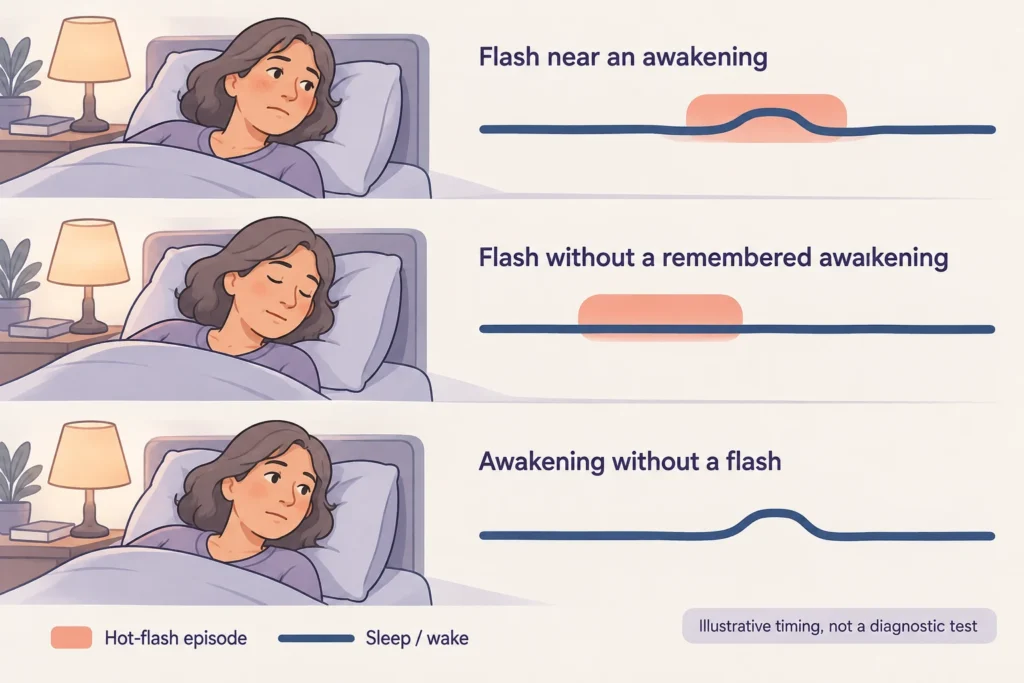
Imagine I’m awake at 3 am, irritated because I need to change my damp shirt, and the spare is in a basket of laundry. By morning, I’m considering another purchase. A better decision is to tell the clinician both things, “I’m waking sweaty and changing doesn’t help me get back to sleep.” The second part also requires attention.
What would make me look beyond menopause?
New hot flushes, coupled with changes during the menstrual phase, lends further explanation to the menopausal transition. For the otherwise healthy adult (45+) with a typical presentation, NICE recommends clinicians can diagnose and manage perimenopause and menopause without blood testing. There are exceptions to this based on younger or older age, use of hormonal contraception, hysterectomy and other atypical symptoms. Further testing to investigate other potential causes should also be considered.[4]
- Reports of heavy snoring, evidence of breathing pauses, or witness accounts of gasping for breath require further assessment for possible sleep-disordered breathing, even in the presence of obvious hot flashes.
- Long periods of being awake on nights with no or little perspiration or being awake after the perspiration has resolved raises the concern of insomnia.
- An urge to move your legs, especially if it is relieved with movement, should not be lumped in with a general complaint of restless sleep.
- New or changed medications, including increased doses, alcohol, pain, or mood issues may play a role. Bring your list of medications and supplements. Don’t suddenly stop your medications.
Treatment should match what is keeping you awake
Systemic hormone therapy is the most effective treatment for hot flashes and night sweats. Whether it’s a good choice for you takes a more personal conversation. The benefit-risk balance is generally more favorable for suitable patients younger than 60 or within 10 years of menopause onset, but those aren’t automatic qualifying rules or a rigid stopping age. Unexplained vaginal bleeding, estrogen-sensitive cancer, blood clots, stroke, heart disease, and liver disease all matter to that discussion.[7]
I’d prefer to talk about the details of the proposed formulation instead of just being asked “are you for or against hormones?” Since systemic estrogen increases the risk of endometrial cancer, it’s recommended that adequate protection be provided for the uterine lining. Transdermal and oral forms of estrogen have different risks, and a patch doesn’t eliminate contraindications. Low-dose vaginal estrogen doesn’t help with night sweats.[4][7]
| Option to discuss | Main target | Tradeoff worth discussing |
|---|---|---|
| Systemic hormone therapy | Hot flashes and night sweats; sleep may improve when these improve | Personal risks, route, uterine protection, and periodic review |
| Selected SSRIs or SNRIs | Vasomotor symptoms; some also treat mood conditions | Nausea, sexual effects, sleep effects, and interactions, including some antidepressants with tamoxifen |
| Gabapentin | Vasomotor symptoms | Drowsiness and dizziness may interfere with next-day functioning |
| Menopause-specific CBT | Symptom distress and interference; associated sleep difficulties | Access and time commitment; not equivalent to eliminating flashes |
| CBT-I | Persistent insomnia | Structured treatment requiring participation, not simply sleep-habit advice |
Different recommendations for antidepressants for hot flashes may also be found. US menopause guidelines recommend several of the SNRIs/SSRIs as well as gabapentin for nonhormonal options, although not all antidepressants have supporting evidence for this. NICE generally doesn’t recommend SSRIs/SNRIs as the first line of treatment for vasomotor symptoms. That’s not to say they won’t help.[4][6]
With newer medicines, ask about monitoring and the next morning
Fezolinetant (Veozah) and elinzanetant (Lynkuet) are US-approved neurokinin-targeted medicines for moderate to severe menopausal vasomotor symptoms, not insomnia treatments. If you’ve been reading the 2023 nonhormone position statement, it predates elinzanetant’s October 2025 approval. These medicines also require different levels of monitoring.[6][9][10][11]
Fezolinetant carries a boxed warning for liver injury and requires liver blood tests before treatment, monthly for the first three months, then at months six and nine. Elinzanetant also requires baseline liver function tests, and follow up transaminase tests at three months. It also carries a daytime impairment warning. If you are taking it and feel impaired, do not drive, operate heavy machinery, etc. This trade-off should also be considered since the goal is to function better during the day.[9][10]
Both medicines have a possibility for liver injury and require stoppage and notifcation of the prescriber if symptoms of yellow eyes or skin, dark urine, pale stools, unusual tiredness, nausea or abdominal pain occur. Do not wait for multiple symptoms to occur at once, especially for the next scheduled blood test. Testing will not ensure there is no liver injury.[9][10]
Before starting either option, bring your full medication list for an interaction review and discuss liver or kidney conditions and pregnancy precautions where relevant. I’d also ask about coverage and laboratory costs up front. The visits and expense are part of living with a treatment, not an afterthought.[9][10]
You don’t need to perfect your bedroom before asking for help
Consider using a fan, removing layers, or wearing a spray-on cooling shirt if it helps. The evidence for cooling techniques is currently lacking to recommend them for vasomotor symptoms. However, the comfort of patients is important and worthwhile. I wouldn’t turn this into a shopping trip or demand you finish a bedtime overhaul prior to discussion treatment.[6]
For the appointment, write down when this first started, any changes to your menstrual cycle or medicine, do you wake hot and sweaty, about how long you stay awake, and how you feel the next day. Do you snore? Do you have periods of apnea (the pauses in your breathing)? Do you have periods of gasping? Also write down anything that you feel may be helpful. A couple notes can go along way to helping explain the pattern. Note taking shouldn’t delay treatment.
Agree on when to review treatment with two questions: are your sweats improving? Are you sleeping and functioning better? These questions can be unrelated. In a randomized study, participants in the CBT-I group had less insomnia than the control group. However, the frequency of daily hot flashes did not change from baseline in the treatment group. Sleep can be treated independently.[8]
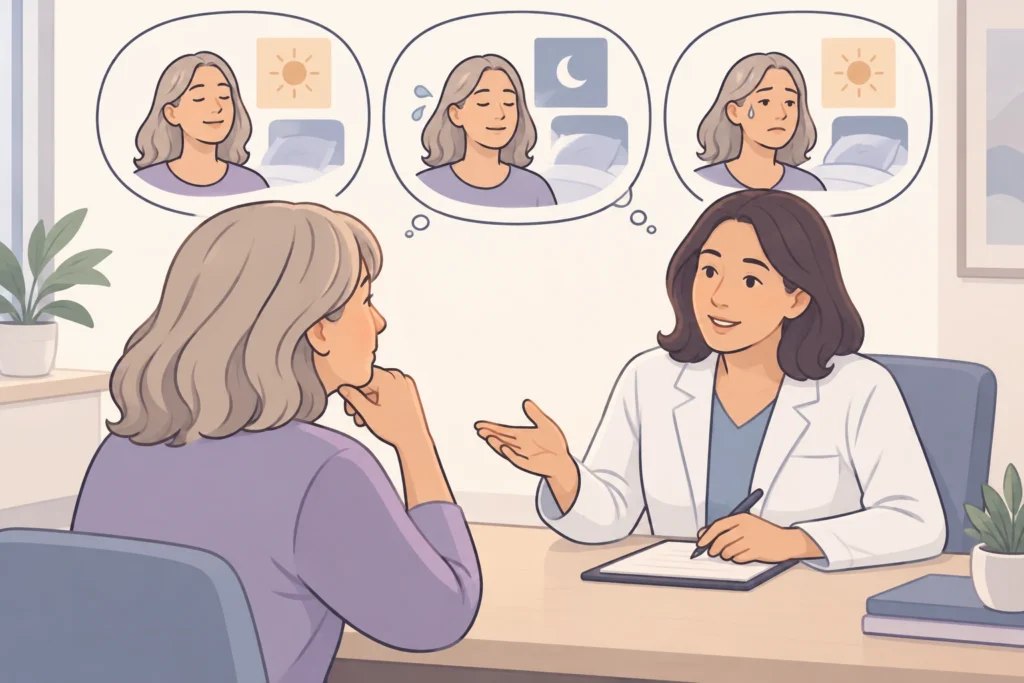
Ease of the sweats is considered an improvement. However, if you're still having issues with long periods of no sleep, bring that result and consider more long-term solutions. The damp shirt and the hour wide-awake are related issues that need to be addressed independently.[3][8]
Sources and references
- Sleep: Magnitude of the impact of hot flashes on sleep in perimenopausal women
- Journal of Clinical Sleep Medicine: Nocturnal Hot Flashes: Relationship to Objective Awakenings and Sleep Stage Transitions
- Sleep Medicine Clinics: Sleep and sleep disorders in the menopausal transition
- National Institute for Health and Care Excellence: Menopause: identification and management, NG23 (2026-04-15)
- NHS: Night sweats
- The Menopause Society, published under its former name: The 2023 nonhormone therapy position statement (2023-06-01)
- Australasian Menopause Society reproducing North American Menopause Society recommendations: The 2022 Hormone Therapy Position Statement
- JAMA Internal Medicine: Telephone Delivered Cognitive-Behavior Therapy for Insomnia in Midlife Women with Vasomotor Symptoms (2016-07-01)
- DailyMed / Astellas Pharma US: VEOZAH prescribing information
- DailyMed / Bayer HealthCare Pharmaceuticals: LYNKUET prescribing information
- US Food and Drug Administration: Drug Trials Snapshots: LYNKUET