
Have your symptoms and iron studies reviewed first. If your routine blood counts were reported as normal, that does not mean an iron study would be normal as well. Before you decide to buy iron for restless legs syndrome (RLS) symptoms, talk with your health care provider. Just having uncomfortable legs does not mean you need iron. I’m more concerned with you getting a test that can answer a medical question vs. you spending money on a bottle that could make constipation worse and make your symptoms harder to manage at night.
Picture me in an imagined pharmacy aisle after another broken night, holding an iron bottle while my phone displays “blood count normal.” I'm tired enough to want that to mean either “buy it” or “forget it.” Instead, I put the bottle back and ask which tests were actually done. The snag isn't willpower; it's missing information.
First, does the discomfort sound like RLS?
Symptoms of RLS usually occur while resting and/or relaxing and seem to get worse over the course of the day, especially in the evening. The urge to move your legs and the sensations usually go away with movement, but then come back and get worse, especially when relaxing and resting. Relief is often only temporary. I’d focus on the symptoms of RLS when you’re in the resting and relaxed state, like while sitting, lying down, reclining, etc. I’d focus on what happens when you stop moving. Bringing that information to your health care provider is important.
That's still a pattern we need to assess clinically. Cramps and nerve pain can sometimes feel like RLS, as can positional discomfort. Movement can be misinterpreted by your bed partner as a result of RLS. If you've had symptoms that have regularly disrupted your sleep, try to describe the timing, what the sensation feels like to you, and whether or not movement brings you relief (not just that your legs are “restless”).
What a normal blood count leaves unanswered
A CBC helps pinpoint anemia with the measurement of hemoglobin. Iron stores can decline before iron-deficiency anemia becomes evident, so a “normal” hemoglobin level will not rule out the need for iron treatment. However, the RLS clinical practice guidelines consider this when making their recommendations. Ordinary blood tests don't assess the levels of iron in the brain. Whether your ferritin levels are low or your TSAT is low, it doesn't necessarily mean that treatment will benefit you.
Ask about your serum iron, TIBC, ferritin, and TSAT. TSAT shows the saturation of iron-binding proteins. A serum iron test by itself is not an extensive assessment.
Elevated ferritin can occur with inflammation and mask iron deficiency. There can also be significant difference in ferritin levels among different laboratory assays. I would not consider a borderline ferritin level as a pass or fail value. It needs to be considered in the context of the rest of the laboratory tests, the patient’s overall health and wellness, and the laboratory method.
Adhere to all instructions before the blood draw. The AASM favors testing first thing in the morning after abstaining from foods and supplements containing iron for at least 24 hours; the 2026 expert algorithm recommends a 48-hour hold of oral iron and fasting studies. The AASM wording does not mean a 24-hour fast. Always follow instructions and do not deviate from iron-containing foods and supplements.[3][4]
The RLS thresholds aren't definitions of anemia
The AASM guideline appeared in the January 1, 2025 journal issue after its September 26, 2024 online release. Its adult iron thresholds below come from expert consensus and haven't themselves been empirically tested. Trials support particular treatments, but that doesn't make these cutoffs proven dividing lines between people who will and won't benefit.[1][5]

| Iron-study finding | What AASM guidance says |
|---|---|
| Ferritin ≤75 ng/mL OR TSAT <20% | Consider oral or intravenous iron. |
| Ferritin between 75 and 100 ng/mL | Consider intravenous rather than oral iron. |
Therefore, a “normal” result may be missing a value that should be discussed for RLS. In the context of the guideline, ferritin thresholds for adult iron status overlap precisely at 75. I would not be comfortable making a decision on treatment (i.e. choose a course of action or select a therapy) based on this value without reviewing the full laboratory results.[1]
Ferritin above 100 isn't always an absolute exclusion. A separate 2026 expert algorithm considers IV iron for chronic persistent restless legs syndrome (RLS) with ferritin levels of 75 to 300 μg/L and a transferrin saturation (TSAT) of less than 45%, using Beckman or equivalent ferritin assays. Those ferritin units are equivalent to ng/mL. This algorithm is in addition to the AASM (American Academy of Sleep Medicine) guidelines, and a ferritin level of 300 is not a target to be achieved.[4]
Why pills and infusions aren't interchangeable
Oral iron may be better than IV iron if there are infusion-related concerns, but intestinal absorption, and gastrointestinal side effects such as constipation may limit its benefits, particularly as ferritin levels rise. IV iron avoids issues with intestinal absorption, but there are risks and potential side effects of the formulations and it requires supervised treatment. Cost and availability should also be considered.
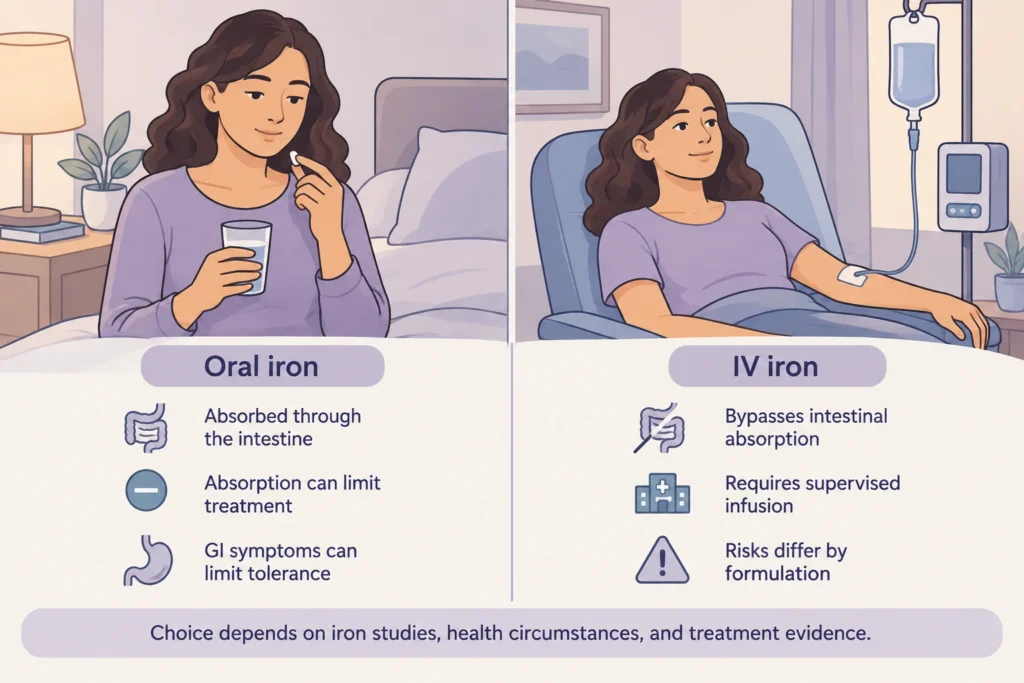
AASM strongly suggests IV ferric carboxymaltose for the appropriate adult population with moderate-certainty evidence. Oral ferrous sulfate is suggested with a conditional recommendation, also with moderate certainty. Other IV formulations do not automatically inherit the same evidence. Strength of recommendation describes how strongly the guideline favors an option; certainty describes confidence in evidence. These recommendations do not automatically suggest that an IV option would be superior to an oral option for every case.
Relief may be delayed or absent. In a randomized study of ferric carboxymaltose for those without anemia, the four week comparison of the primary outcome was not significant, but the twelve week comparison was. I would not interpret this as an implicit time limit to demonstrate an effect, but would support the need for follow-up.[8]
What to ask before treatment
Bring actual lab results and a list of medications and supplements. Iron has been shown to interfere with absorption of levothyroxine and levodopa. Those at risk for iron overload require particular consideration. Those with low phosphate levels may need to have it monitored. Systemic iron deficiency should be evaluated to determine the cause instead of always replacing iron.
Keep iron out of the reach of children; an overdose can be fatal. Do not wait for symptoms to appear to seek help if you suspect a child has taken iron. Similarly, pregnancy and significant kidney problems also require special assessment, and you should not use the general adult thresholds.
A good first step for the visit would be to ask, “Do my symptoms warrant a consideration for restless leg syndrome? Have we checked ferritin and transferrin saturation and not just a blood count?” If treatment is planned, inquire about the logic behind that treatment, when the treatment will be reassessed, and what will happen if you don’t improve. The 2026 guideline states that after initiation of treatment with iron, ferritin level should be reassessed after 3 months. Your health care professional will determine the iron management plan. Persistent symptoms should be further assessed, and not automatically, more iron should be prescribed.
Sources and references
- American Academy of Sleep Medicine; Journal of Clinical Sleep Medicine: AASM clinical practice guideline (2025-01-01)
- American Academy of Sleep Medicine; Journal of Clinical Sleep Medicine: AASM systematic review, meta-analysis, and GRADE assessment (2025-01-01)
- American Academy of Sleep Medicine: AASM RLS quality-measure update
- Scientific and Medical Advisory Board of the Restless Legs Syndrome Foundation; Mayo Clinic Proceedings: An Updated Algorithm for the Management of Restless Legs Syndrome (2026-09)
- American Academy of Sleep Medicine: AASM guideline release announcement
- Journal of Clinical Sleep Medicine; Sleep Research Institute; Mayo Clinic: IV iron with normal ferritin: stratified subanalysis (2025-12-01)
- NIH Office of Dietary Supplements: Iron, Health Professional Fact Sheet (2025-09-04)
- Movement Disorders: Ferric carboxymaltose in nonanemic iron deficiency: randomized trial (2017-10)
- Mayo Clinic; Journal of Clinical Sleep Medicine: Serum ferritin measurements differ according to the assay used (2025-01-01)