

Waking with an urgent need to pee is different from waking because of noise, discomfort, or restless sleep and then deciding to use the bathroom. Both can lead to the same hallway trip. Your remembered sequence is a useful clue, not proof of what woke you. If the trips keep interrupting your sleep, I’d look beyond evening drinks rather than keep tightening the rules around water.[1][3]
Nighttime urination, called nocturia, can involve extra urine production, trouble storing or emptying urine, disrupted sleep, or several of these together. “It’s just aging” doesn’t tell you which needs attention. You don’t have to settle for that explanation.[1][3]
The trip tells you less than the pattern
Picture me in an imagined night: a door clicks shut, I’m awake, and I head to the bathroom because I’m already up. Back in bed, I’m annoyed enough to decide tomorrow’s dinner gets no water. Then I reconsider: I remember the door, not a desperate bladder. I’d note that uncertainty instead of turning it into a drinking ban.
Urine has a lot of useful information. The number one rule is to never underestimate your bladder. One of the main reasons you’re not able to empty your bladder could be due to storage issues. A weak stream, a slow starting stream, or a sense of fullness after urinating indicates you’re not completely emptying your bladder. A small urine output doesn’t always mean you have a small bladder.[1][7]
Sleep-related issues are often as complicated as the ones that occur while you're awake. For example, loud snoring, witnessed breath-holding, or waking up gasping increases the likelihood of obstructive sleep apnea, which can cause sleep fragmentation and increase nighttime urine production. Long periods of time fully awake may also require intervention. It is important to distinguish if these periods of fully awake time are related to nocturia, and if they require intervention.[1][5]
Why the evening drink may be only part of it
There are other habits you should consider besides the presence of a late drink. Alcohol can cause or increase urine production and disrupt sleep, and caffeine, although it can increase sleep latency, can affect urinary symptoms for some people. So, you should consider both, but keep asking questions, as there can be multiple factors at play.[1][3]
Swollen legs can also provide a clue. Fluid collects there during the day and can return to the circulation at night leaving the kidneys to remove more at night. Diabetes can also increase urine production and is commonly associated with excessive thirst and daytime urination. Prostate obstruction can also lead to frequent urination, but with less urine being produced. The trip count alone can’t distinguish these causes.[1][3]
There are other possible causes of excessive urination including some medications and supplements, fluid retention, and sleep. Medications which are diuretics or “water pills” are worth discussing with your pharmacist or prescriber. Bring the name and dose of the medication with you as well as the time you take it. Ask them, “Could this medication be causing this and could a change in the timing of when I take it help improve my condition?” You should not change the dosing schedule on your own.[1]
For drinking, there are some changes I would suggest. Spread drinks out more during the day instead of grouping them all together at the end of the day. I would also focus on the size of the last drink of the day, and notice if alcohol or caffeine at the end of the day affects the quality of your sleep. This is different from just drinking very little during the day to “save” yourself for drinking at night. Don’t focus on reducing your total fluid intake. There isn’t a set amount of fluid that is ideal for everyone, and a prescription for a heart or kidney condition takes precedence over this.[1][3]
Give the record three days, not an indefinite assignment
Three ordinary days of a bladder-and-sleep record can give a clinician something more useful than “I’m up all night.” It helps to include your daytime urination and hydration as well. This gives context to high urine output during the day versus at night. Providing the size of your drinks gives a better measurement than just guessing “large” or “small” drinks.[1][2][4]
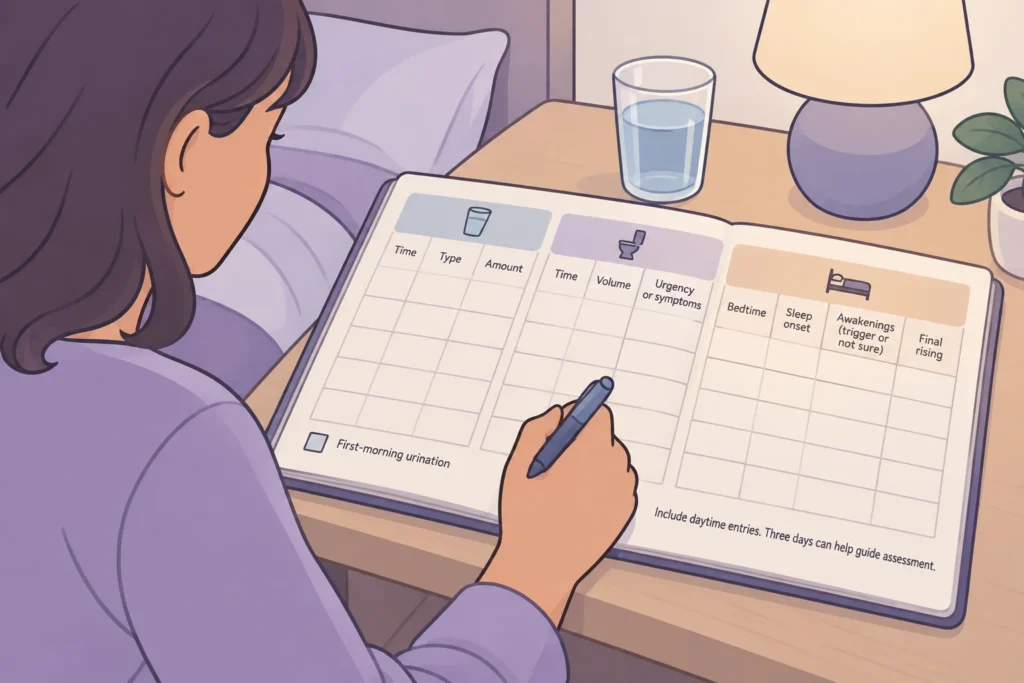
- For each drink, record the time, type, and amount.
- For each time you urinate, record the time and amount, and include the first urination of the day.
- Record your bedtime, approximate sleep onset, nighttime awakenings and getting up time each day.
- -Add notes about urgency, leakage, pain and/or trouble emptying for both daytime and nighttime. For awakenings, add what you first noticed (or "not sure"), along with an approximate duration of the awakening.
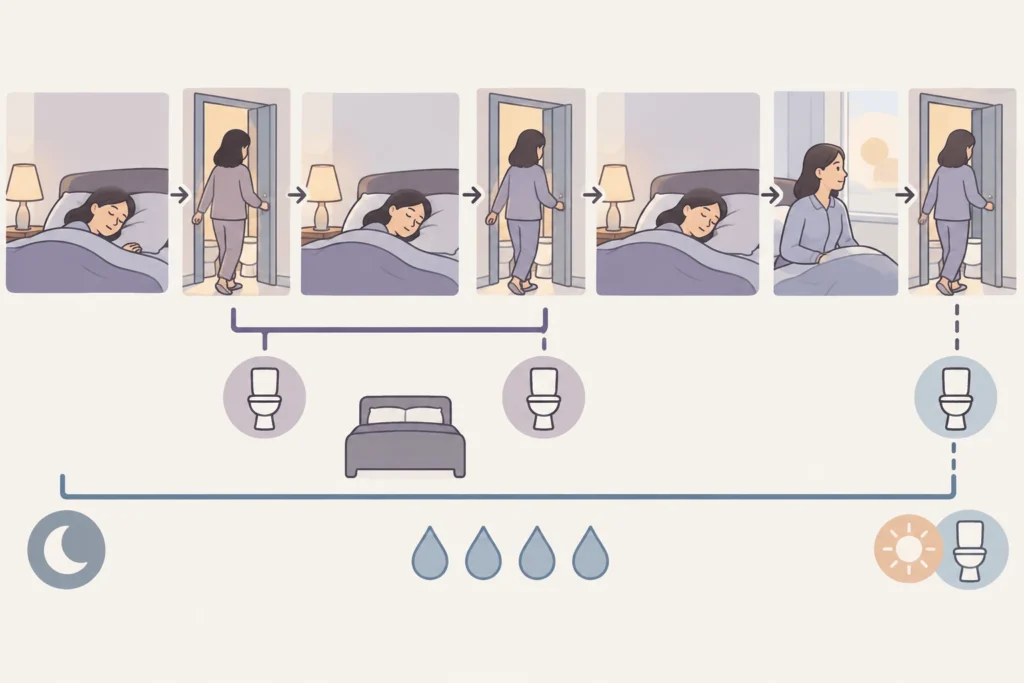
-There is one slight accounting difference: the first urination of the day happens after you get up for the day; however, that urine has accumulated while you slept, and thus should be counted as part of the overnight total. Identify this urine separately from the others so the person reviewing your data can tell the difference.[1]
-I'd rather you estimated sleep times than have you awake all night and measure every single thing. Three days' worth of data should be enough. You can stop recording and bring what you have. The main idea is to see if the amount of urine you're making is significantly higher than normal and/or if you're making lots of trips to empty your bladder. This helps distinguish true high urine volume and/or frequency from normal. Measuring shouldn't be done to the extent of ruling out infections, diabetes, retention, sleep apnea, etc. If measuring is impractical, your observations should still be done. You can bring them with you to have your needs assessed.[1][3][4]
When I wouldn’t keep experimenting with the routine
If the issue persists, and/or worsens, and/or interferes with your sleep or ability to function during the day, a routine appointment is not appropriate. You should seek care asap. Two trips or more in a night is considered clinically significant; however, if you are only taking a few trips and then take a long time to fall back to sleep, or aren’t able to fall back to sleep, that’s also a reason to seek care. Mention to the clinician daytime urgency to urinate, weak stream, swelling, thirst or breathing symptoms, and anything else that is of concern.[1][3]
At routine visits, expect to discuss issues with sleep, fluid intake, medicine, and urinary symptoms. Don’t expect to have the evening tea discussion and just be given the verdict. Sometimes a urine test is done as part of the initial assessment. If there are any clues in the testing or assessment, additional tests like blood tests, checking for urine left in the bladder after urinating, or sleep studies may be done. A good starting point is: “These trips are breaking up my sleep. Can we look at urine production and emptying, and other potential causes of sleep problems?’ You don’t need to come with the explanation already figured out.[1][3]
Sources and references
- Canadian Urological Association: Canadian Urological Association best practice report: Diagnosis and management of nocturia (2022-05-10)
- European Association of Urology: EAU Guidelines on Non-neurogenic Female LUTS: Disease Management
- American Academy of Family Physicians: Nocturia: Evaluation and Management (2025-06)
- International Continence Society: Assessment of Lower Urinary Tract Symptoms
- Minerva Urology and Nephrology: From nocturnal awakenings to nocturnal voiding: the relationship between insomnia and nocturia, a systematic review (2023-11-13)
- NIDDK: Symptoms & Causes of Bladder Infection in Adults (2024-04)
- NIDDK: Symptoms & Causes of Urinary Retention