
TL;DR
- Going to bed early only changes the clock. It does not automatically fix your body clock, sleep pressure, stress level, or bedroom setup. (nhlbi.nih.gov)
- The most common routine-breakers are inconsistent wake times, bright light and screens in the last hour, late caffeine or alcohol, and using bed as a place to work, scroll, or worry. (nhlbi.nih.gov)
- Before you buy another sleep product, find your top two friction points with the BEDTIME Friction Score in this article and fix the cheapest problems first.
- If you have loud snoring, gasping, heavy daytime sleepiness, or persistent insomnia, a routine tweak may not be enough. That is a reason to talk with a healthcare professional. (nhlbi.nih.gov)
A lot of people assume an earlier bedtime should solve a bad night. They move from 11:30 p.m. to 9:45 p.m., expect to feel better in three days, and end up lying there annoyed, wide awake, or waking at 3 a.m. The mistake is simple: bedtime is only one part of sleep. Your body also responds to timing, light, caffeine, stress, and habit. If those still point in the wrong direction, getting under the blanket sooner does not help much. Adults generally need at least 7 hours of sleep, yet a large share of U.S. adults still fall short. (cdc.gov)

What time you went to bed is not as important as knowing what parts of your life keep your body from staying sleepy. You can work on your daily schedule and fix all of the above.
Going to bed early is not the same as being ready for sleep
Three forces matter more than the bedtime on your phone alarm. First is your body clock, which is shaped by light and by the consistency of your sleep schedule. Second is sleep pressure, the biological drive that builds while you are awake; caffeine can interfere with that process by blocking adenosine. Third is arousal, meaning mental and physical alertness. If you bring bright screens, work stress, arguments, alcohol, or a late coffee into the last part of the evening, you can be physically in bed while your brain is still in daytime mode. (nhlbi.nih.gov)
That is why “I’m going to bed earlier now” often fails. The bedtime changed, but the cues around it did not. A stable wake time, dimmer light, less stimulation, and fewer chemical disruptors usually matter more than pushing bedtime earlier by 60 or 90 minutes. (nhlbi.nih.gov)
Use the BEDTIME Friction Score
Assign 0-2 points for each category of your routine (0 = infrequent problem; 1= a few times per week; 2= often). The objective isn’t an overall total, but rather the two categories that hinder your performance most frequently.
- B – Body clock mismatch: Your wake time drifts by more than about an hour on weekends, or you are trying to force sleep long before you feel sleepy. (nhlbi.nih.gov)
- E – Evening stimulants: You have caffeine late in the day, alcohol close to bed, nicotine, or a hard workout too close to bedtime. (nhlbi.nih.gov)
- D – Device and light load: Phones, tablets, TV, bright lamps, or a bright alarm clock are still in play during the last hour. (nhlbi.nih.gov)
- T – Task spillover: Work, email, budgeting, family logistics, and planning are still active in your head when you lie down.
- I – In-bed habits: You use bed for scrolling, streaming, worrying, or trying to “make yourself sleep” instead of using it as a cue for sleep. Stimulus-control strategies in CBT-I are built around changing this pattern. (nhlbi.nih.gov)
- M – Micro-environment: The room is noisy, bright, stuffy, too warm, or full of interruptions from pets, kids, or a partner. (nhlbi.nih.gov)
- E – Elsewhere causes: Snoring, gasping, pain, reflux, medication side effects, anxiety, depression, or shift work may be doing more damage than the routine itself. (medlineplus.gov)
This score suggests the following; A low score (0-4) means possibly only a tune-up is required to your routine. A medium score (5-8) means that likely you have 2-3 recurring frictions in your daily routine. 9-10+ means no additional items should be added to those creating disruption and you should look to decrease disruptions; In reality, many times by just addressing the top two score areas the individual will have an easier time achieving improvements rather than attempting a complete overhaul to their nightly routine.
What usually breaks the routine
| What your night looks like | Most likely friction | Best first fix | What to buy or escalate only if needed |
|---|---|---|---|
| You get in bed early but do not feel sleepy for 45 to 90 minutes | Body clock mismatch or too much late light | Hold a stable wake time and dim screens and room light during the last hour | If this keeps happening for weeks, look at CBT-I or a clinician |
| You fall asleep fast but wake up at 2 or 3 a.m. | Alcohol, stress spillover, or environmental disruption | Move alcohol earlier or skip it for a week, and separate planning from bedtime | If wakings stay frequent, check for pain, reflux, anxiety, or snoring |
| You are exhausted all day but oddly alert once you lie down | Stress arousal or bed becoming a place for scrolling and worry | Create a 15-minute brain-dump and keep bed for sleep, not phone time | If anxiety is a major driver, consider therapy or CBT-I |
| You sleep long enough on paper but wake up foggy | Fragmented sleep, snoring, or poor sleep quality | Track wakings, ask a partner about snoring or gasping | Discuss sleep apnea symptoms with a healthcare professional |
| Your weeknights are disciplined but weekends drift by two hours | Body clock instability | Keep weekend wake time within about an hour of weekdays | If work schedule makes this impossible, use a backup plan built around light and anchors |
| You keep buying sleep products but nothing sticks | You are solving the wrong problem | Use the BEDTIME score and fix the top two frictions first | Spend only after a two-week test shows the environment is the limiting factor |
The table matters because it forces a useful order of operations. If the real problem is late caffeine, a $90 sunrise clock will not rescue the night. If the problem is loud snoring, a lavender spray will not fix it either. Match the fix to the failure pattern first.
A realistic reset with numbers
Consider a composite example. Dana is 36, needs to be up at 6:15 a.m., and keeps telling herself she has a “good” routine because she is in bed by 9:45 p.m. But her last coffee is at 4:30 p.m., she answers messages in bed until 10:20, and her Friday-to-Sunday wake time slides to 8:30 a.m. Her BEDTIME score is 9: Body clock mismatch 2, evening stimulants 2, device and light load 2, task spillover 2, in-bed habits 1.
Her cheapest useful reset is not a pile of new products. It is to move the last caffeine to noon, charge the phone outside the bedroom, spend 10 minutes at 9:00 p.m. writing tomorrow’s to-do list, and keep weekend wake time no later than 7:15 a.m. If the bedroom is stuffy, she might add a $25 fan or a $15 eye mask. Total test cost: around $40, not $200. That is the practical consumer lesson here. When the routine fails, spend on friction you have confirmed, not frustration you are guessing at.
A 7-night reset that does more than tell you to “relax”
- Pick one wake time and protect it every day for the next seven days. Do not focus on bedtime first; anchor the morning.
- Cut late caffeine aggressively. If your sleep is shaky, make lunch your last caffeinated drink. NHLBI notes caffeine can affect sleep for up to 8 hours. (nhlbi.nih.gov)
- Use the last hour before bed as quiet time. Lower room light, stop doomscrolling, and avoid bright screens. NHLBI specifically warns that bright artificial light in the late evening can delay sleep by disrupting melatonin release. (nhlbi.nih.gov)
- Move planning out of bed. Write down tomorrow’s tasks, packed lunch items, pickups, or bills before you start winding down.
- Keep bed for sleep, not administration. If you are awake and frustrated, get up and do something calm in dim light until you feel sleepy again. Stimulus-control therapy in CBT-I is built on this principle. (nhlbi.nih.gov)
- Test alcohol honestly. If you use a drink to “wind down,” remove it for several nights and watch whether you stop waking in the middle of the night. NHLBI notes alcohol may make you drowsy at first but can lead to lighter, more disrupted sleep. (nhlbi.nih.gov)
- Observe your morning results, not your mid-night ones. Write down your time from when you first laid down until you fell asleep, how many awakenings occurred, how difficult it was for you to leave bed after waking (if you used multiple alarms for this reason), etc.
This reset works because it targets the most common hidden problem: your body is getting mixed signals. You want sleep, but your light exposure, schedule, stimulants, and mental load are still sending wake cues. When those cues line up, bedtime stops feeling like a fight. (nhlbi.nih.gov)
Common mistakes that make an early bedtime backfire
- Trying to “catch up” by going to bed 90 minutes earlier while leaving weekend wake time untouched. Regularity matters. (nhlbi.nih.gov)
- Treating the last hour like regular daytime: email, TV glare, online shopping, spreadsheets, and social feeds. Late bright light can push sleep later. (nhlbi.nih.gov)
- Assuming alcohol counts as a sleep aid. It may help you doze off, but it can make sleep lighter and increase night waking. (nhlbi.nih.gov)
- Ignoring late caffeine because you still feel tired. Feeling tired and being physiologically ready to sleep are not the same thing. Caffeine can still interfere hours later. (nhlbi.nih.gov)
- Using bed as a waiting room for sleep. The longer you lie there annoyed, the more your brain starts linking bed with frustration instead of sleep. CBT-I approaches try to reverse that pattern. (nhlbi.nih.gov)
- Buying a product before running a two-week test. Many people try to purchase their way out of a timing problem.
Before you buy another sleep product
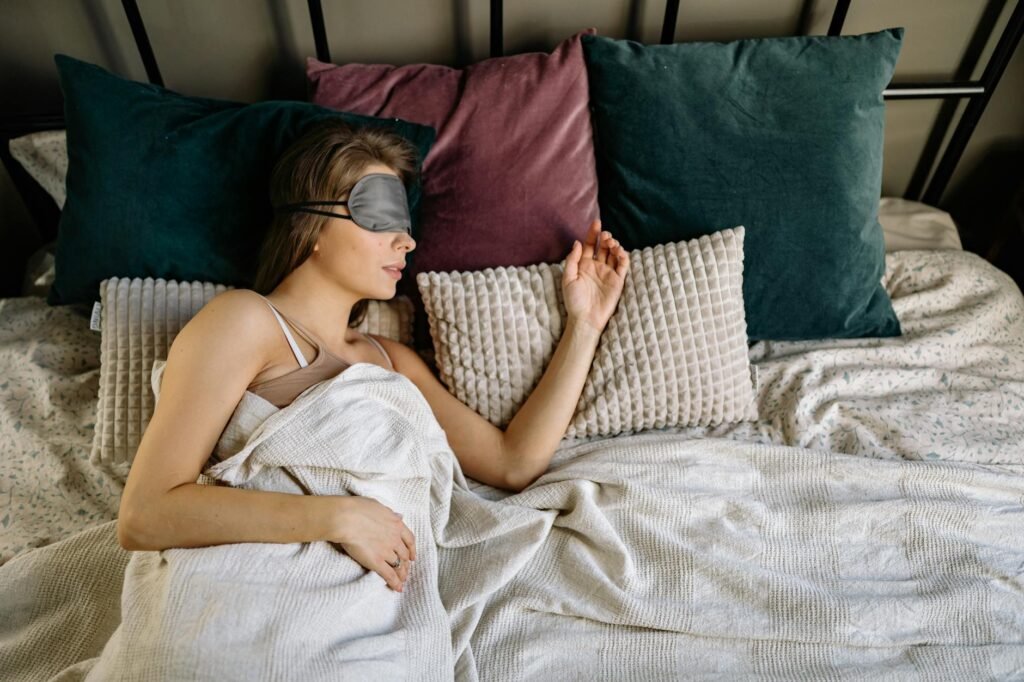
There are also several ways that a poor sleeping routine can contribute significantly to wasting money over time (ex. unnecessarily purchasing supplements you aren’t going to evaluate; upgrading bedding that doesn’t address the problem; buying a smart light and then never programming it; purchasing a product that solves a problem you don’t actually have). Start by utilizing free options, then low cost environmental options (like curtains or blinds) before getting to professional assistance if symptoms warrant going beyond just adjusting your nightly routine. In many cases, using items like notebooks, fans, eye masks or utilizing the other room for your phone charger might be more successful than purchasing yet another “sleep solution” product.
When the obvious plan is not enough
Sometimes the routine is not failing because you lack discipline. It is failing because the problem sits elsewhere. MedlinePlus notes that chronic insomnia is often secondary to another issue, including medical conditions, medications, other sleep disorders, or substances such as caffeine, tobacco, and alcohol. Shift work can also throw your sleep-wake cycle out of alignment. (medlineplus.gov)
- If your schedule changes every week, protect the wake time on your most important mornings and use light exposure strategically: more light early in your wake period, less bright light late. (nhlbi.nih.gov)
- If you have a baby, caregiving duties, or a noisy household, aim for a good-enough routine with one anchor and one wind-down step instead of a perfect ritual.
- If stress is the main driver, move the hard thinking earlier. A bedtime routine cannot carry the full weight of unprocessed work and family pressure.
- If you snore loudly, gasp, or are persistently sleepy during the day, ask about sleep apnea rather than endlessly editing your routine. Those symptoms are a reason to seek evaluation. (nhlbi.nih.gov)
- If the problem has lasted for weeks or longer, CBT-I is worth knowing about. NHLBI describes it as a first treatment option for long-term insomnia and notes that it can be very effective. (nhlbi.nih.gov)
How to pressure-test your routine instead of guessing
- Run your reset for 7 to 14 nights before deciding it failed.
- Track five numbers: bedtime, estimated time you fell asleep, number of wakeups, wake time, and last caffeine time.
- Add two yes-or-no notes: screens in the last hour, alcohol within three hours of bed.
- Rate your morning on a simple 1 to 5 scale for sleep quality and ease of getting up.
- At the end of the test, look for patterns, not perfection. The routine is working if sleep onset is shorter, wakeups are fewer, or mornings feel less punishing.
- If nothing improves after a fair test, escalate the question. The issue may be insomnia, sleep apnea, a medication effect, or a schedule problem rather than a missing routine step. (medlineplus.gov)
- If you want a template, NHLBI offers a sleep diary you can use to record sleep and daytime habits that may affect sleep. (nhlbi.nih.gov)
It’s important to verify your routine, as it is easy to misinterpret your sleep. A lot of individuals remember just one bad wakeup and determine that their whole sleep routine failed, or buy a product after one terrible week without changing the cause of their trouble. A concise sleep log will provide you with a better outcome than frustration; it will provide a record of what you did.
Bottom line
Your night routine can fail even when you go to bed early because early is not the same as sleep-ready. Most routines break on one of four points: unstable timing, too much late stimulation, too much in-bed wakefulness, or a problem that is bigger than routine. Audit the friction, fix the cheapest high-payoff issues first, and verify the result over at least a week. If the pattern includes snoring, gasping, or persistent insomnia, move from self-experiment to professional help. (nhlbi.nih.gov)
FAQ
Why do I feel tired all evening but suddenly awake when I get in bed?
That usually points to a mismatch between sleepiness and arousal. You may be tired, but late light, screen time, task spillover, caffeine, or stress is still telling your brain to stay alert. NHLBI notes that bright artificial light in the late evening can interfere with melatonin release, and caffeine can interfere with the sleep drive. (nhlbi.nih.gov)
Is going to bed at the same time or waking up at the same time more important?
For many people, the wake time is the stronger anchor. A stable wake time helps keep the body clock consistent, and NHLBI advises keeping the sleep schedule similar on weekdays and weekends, with the difference limited to about an hour. (nhlbi.nih.gov)
Does one glass of wine actually hurt sleep?
It can. NHLBI says alcohol close to bedtime may make it easier to fall asleep but can lead to lighter sleep and more waking during the night. If middle-of-the-night wakeups are your problem, alcohol is worth testing honestly. (nhlbi.nih.gov)
When should I stop blaming my routine and talk to a doctor?
If your sleep trouble is ongoing, if you are exhausted despite enough time in bed, or if there is loud snoring, gasping, or significant daytime sleepiness, routine changes may not be enough. MedlinePlus notes that chronic insomnia is often tied to another issue, and NHLBI lists snoring, gasping, and daytime sleepiness as common sleep apnea symptoms. (medlineplus.gov)
What is the smartest first purchase if I really do need one?
You should make purchases when your record shows that something about the environment is preventing you from achieving success. The first few purchases can often be very inexpensive and quite simple! For example: purchasing a fan, or an eye mask, or a simple lamp timer could be the best first step in helping you solve your problem. However, if it is due to timing, or light, or stimulants, then your first purchase should not be a thing!
References
- CDC: About Sleep – https://www.cdc.gov/sleep/about/index.html
- CDC National Center for Health Statistics: Short Sleep Duration and Sleep Difficulties Among Adults, United States, 2024 – https://www.cdc.gov/nchs/products/databriefs/db559.htm
- NHLBI: How Sleep Works – Your Sleep/Wake Cycle – https://www.nhlbi.nih.gov/health/sleep/sleep-wake-cycle
- NHLBI: Sleep Deprivation and Deficiency – Healthy Sleep Habits – https://www.nhlbi.nih.gov/health/sleep-deprivation/healthy-sleep-habits
- NHLBI: Insomnia Treatment – https://www.nhlbi.nih.gov/health/insomnia/treatment
- MedlinePlus: Insomnia – https://medlineplus.gov/insomnia.html
- NHLBI: Sleep Apnea Symptoms – https://www.nhlbi.nih.gov/health/sleep-apnea/symptoms