
Protect a realistic sleep opportunity after work before attempting to adjust your body clock. For example, if your work schedule allows for consistent sleep timing or a bit of overlap between workday and days-off sleep, you may be able to successfully manipulate your body clock. However, if your work schedule does not allow for consistent sleep timing and you attempt to force yourself to be a night person by resetting your body clock, you are likely to compromise your ability to get the sleep you need. I would rather give you the opportunity to protect a realistic amount of sleep than give you a schedule that your body cannot really adapt to.
In the meantime, if you are having trouble keeping your eyes open or if you find yourself drifting out of your lane, it is better to stop. You should arrange for a safe place to rest rather than trying to push through. Fatigue can be reported before driving or other safety-sensitive work.
Being exhausted doesn’t guarantee a long daytime sleep
When you are up all night, there is a build-up of pressure that can make you more likely to fall asleep. This can help you understand why you may be able to fall asleep quickly when you first go to bed, but may not be able to sustain the sleep. Noise and other stimuli can help you understand why you may be waking up before you want to.
While you do have some control over the stimuli you can protect yourself against, you may be wasting your time trying to control your body clock in the long-term. You should protect your sleep and consider if your work schedule actually gives you the opportunity to reset your body clock.
Your roster changes the goal
| Your shift pattern | What’s worth aiming for | The tradeoff |
|---|---|---|
| Stable nights, with flexibility on days off | Keep the main sleep period reasonably consistent across the week. | A night-oriented schedule can consume daytime family and social time; complete adaptation isn’t guaranteed. |
| Stable nights, but daytime obligations on days off | Consider keeping part of your workday and days-off sleep periods overlapping. | This preserves some consistency without requiring identical bedtimes, but may still conflict with caregiving. |
| Rapidly rotating or occasional nights | Protect recovery sleep and any feasible supplemental sleep before the next shift. | Repeatedly trying to shift the whole body clock may be impractical when the roster changes again. |
The NIOSH model suggests that workday/day off schedules for sleep are compromise solutions and not requirements. They also point out the dangers of staying awake all day during the transition to the night shift. While adjusting to the day shift from the night shift, don’t view a day of no sleep as a necessary part of returning to a normal sleep schedule; give yourself a chance to recover with a daytime sleep if possible.
There is no set number of days after which a person is expected to adapt to a new schedule. The AASM's [May 2025 public-comment-era guidance](https://aasm.org/wp-content/uploads/2025/08/Extrinsic-CRSWD-CPG_SWD_May2025.pdf) states that adaptation to a new schedule is unrealistic for frequent or rotating shift work. A [May 2026 conference supplement report](https://doi.org/10.1093/sleep/zsag091.0777) approves final, conditional recommendations. It does not, however, describe the report in detail. I would use that report for goal-setting purposes in regard to new, stable nights, and not to state that a goal of adaptation to a new schedule is attainable.[1][2]
When the household is awake and you need to sleep
Picture me, in an imagined morning after a night shift, arriving home at 8 a.m. with school pickup at 1 p.m. The washing machine is beeping and I am irritated enough to start unloading it. Then I notice what that choice costs; my only significant sleep opportunity. I put the laundry back the way it was, asked for quiet until 12:30 and contacted the person working to see if they could cover the second sleep period.
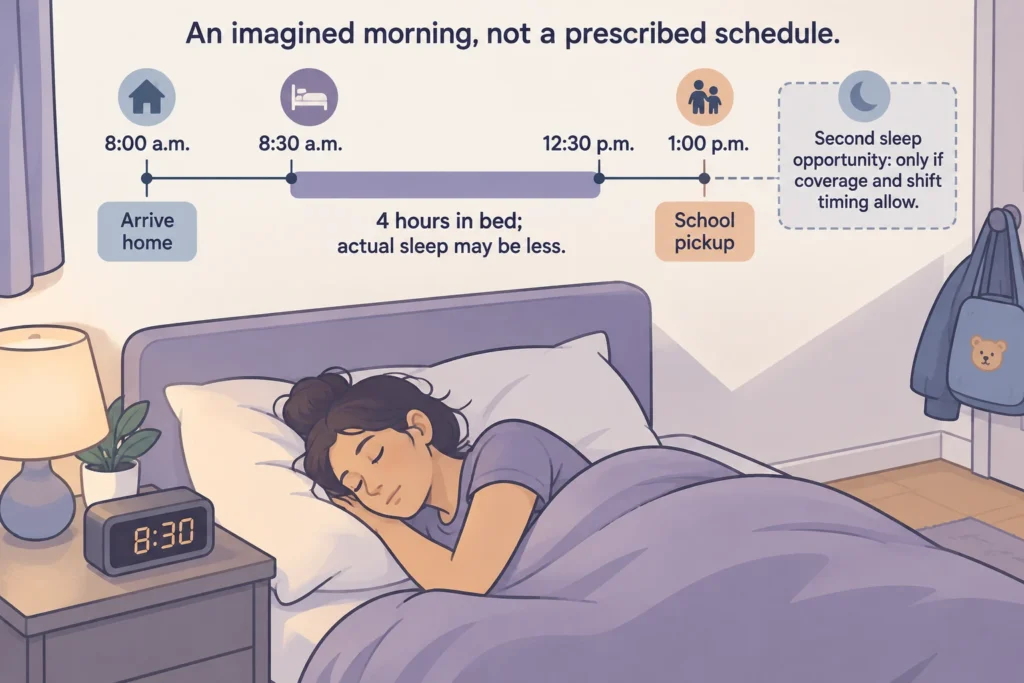
That morning offers four hours in bed, from 8:30 a.m. to 12:30 p.m., not necessarily four hours asleep. [NIOSH says most adults need seven to nine hours of sleep each day](https://www.cdc.gov/niosh/motor-vehicle/driver-fatigue/). Adding a second three-hour window would bring the opportunity to seven hours, with time spent falling asleep or awake still coming out of that total. The gap is real, even if you fall asleep the moment your head touches the pillow.[7]
[NIOSH recommends getting to bed promptly after night work and using supplemental naps when needed](https://www.cdc.gov/niosh/work-hour-training-for-nurses/longhours/mod9/05.html). Adding in a second sleep period may be of benefit if you're unable to fit the first long period in, but the math isn’t always going to show you’re fully recovered and fit for duty. If there isn’t a second window available, I would look to see what else is coming up, and what the school roster looked like, before adding a wind down period. A quieter room may help protect an already available opportunity. It can’t create an unavailable opportunity.[4][7]
Give households actual hours to protect. You can’t protect them if you’re not fully resting. For example, “I’m sleeping until 12:30. Please don’t bring me non urgent questions and errands until then.” Get agreement on who will handle the children, dependent adults, pets and who will answer the door. Just because you’re home, doesn’t mean you’re always available.
You might want to keep the lights off and/or block sound, instead of making a to do list. Blocking alerts doesn’t help if you’re also blocking signals you’re responsible for hearing. If you’re the only caregiver, arrange to have that coverage first. Your need for sleep is important, but it doesn’t make an unattended responsibility disappear.
Light advice has to fit the journey home
Light can make you more alert, but timing of light can also help set your body clock. Shifting your body clock is not always the goal. The [AASM’s May 2025 draft guidance](https://aasm.org/wp-content/uploads/2025/08/Extrinsic-CRSWD-CPG_SWD_May2025.pdf) and [NIOSH’s light guidance](https://www.cdc.gov/niosh/work-hour-training-for-nurses/longhours/mod9/03.html) mention timing and alertness concerns.[2][6]
For the sleep period ahead, a dark bedroom and less unnecessary bright light once you’re home are practical starting points. I wouldn’t carry that advice onto the road at the expense of seeing clearly or staying alert. [NIOSH identifies having someone else drive as the safest context for using sunglasses to reduce post-shift light exposure](https://www.cdc.gov/niosh/work-hour-training-for-nurses/longhours/mod9/03.html). Don’t use dark lenses as a body-clock intervention if they compromise your view or worsen drowsiness, and keep the lighting you need for safe work.[4][6]
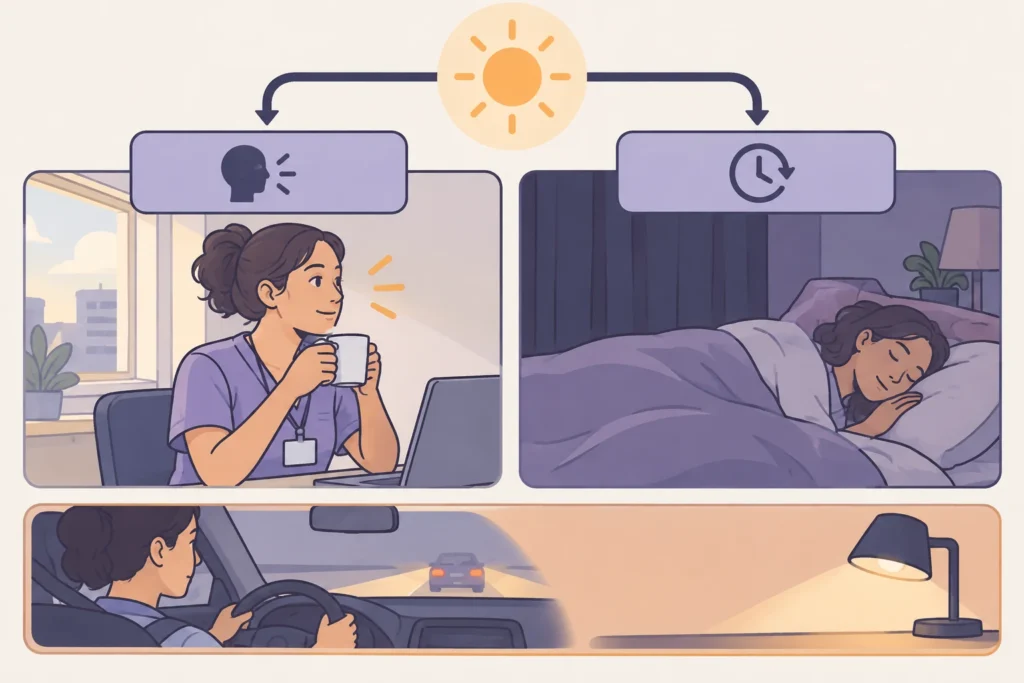
You don’t have to start with an exact light schedule or light box. A [2025 review of reviews](https://doi.org/10.1016/j.smrv.2025.102110) suggests that there is not enough evidence from higher quality reviews to conclude which individual countermeasures improve the sleep of shift workers, and that doesn’t mean other strategies, like light and naps, aren’t helpful.[8]
When protected time still isn’t enough
Tell your supervisor if you need to take an immediate break to avoid unintended dozing or if you can't stay awake to perform a safety-related task. If your sleep difficulties aren’t improving despite providing you with a workable opportunity to sleep, and/or you continue to feel excessively sleepy while at work, while caring for others, or while traveling and it's impairing your ability to perform your job, seek a clinical assessment. If you have near misses or dozing while performing a safety-related task tell your supervisor and ask to be immediately removed from the task.
Create a log showing time spent in bed, estimated sleep time, naps, interruptions, caffeine and med use, and a time when sleepiness becomes dangerous. Also include symptoms on days off. This helps differentiate too little opportunity from shift work disorder, persistent insomnia, and other sleep or health issues. A schedule alone can not assist in making the diagnosis.
Ask " Is my available sleep time too short? Am I unable to sleep during it? Are both of these issues happening to me? What can change before my next run of nights?" Depending on what issues are occurring, different help will be offered. It should not be necessary for you to continue improving your bedtime routine when hours are missing.
Sources and references
- American Academy of Sleep Medicine / SLEEP: AASM shift work disorder recommendations reported in SLEEP, May 2026 (2026-05-08)
- American Academy of Sleep Medicine: Management of Shift Work Disorder, May 2025 version
- CDC / NIOSH: Desynchronization of Homeostatic and Circadian Processes
- CDC / NIOSH: Coping with the Night and Evening Shifts: Sleep
- CDC / NIOSH: Coping with the Night and Evening Shifts: Sleep Continued
- CDC / NIOSH: Coping with the Night and Evening Shifts: Light
- CDC / NIOSH: Driver Fatigue on the Job (2024-04-03)
- Sleep Medicine Reviews: Which individually-directed non-pharmacological interventions are effective at improving sleep outcomes in shift workers? A systematic review of systematicறெுen (2025-08)